Let me be upfront about something. If you're reading this page, you've probably spent months — maybe years — exhausting every other option. Medications that blunted you. Therapy sessions that helped a little but not enough. And somewhere along the way, someone mentioned amygdalotomy surgery. And now you're wondering: what actually happens after the operation?
I've worked with hundreds of international patients coming through India for functional neurosurgery, and the question I get most often isn't "what does the surgery cost?" or "which hospital should I choose?" It's this: "What will my life look like on Day 1, Week 2, Month 3 — after the procedure?"
That's exactly what this guide answers. No vague reassurances. Just a day-by-day breakdown, honest data on side effects, published clinical success rates, and composite stories from real patients who made the journey to India.
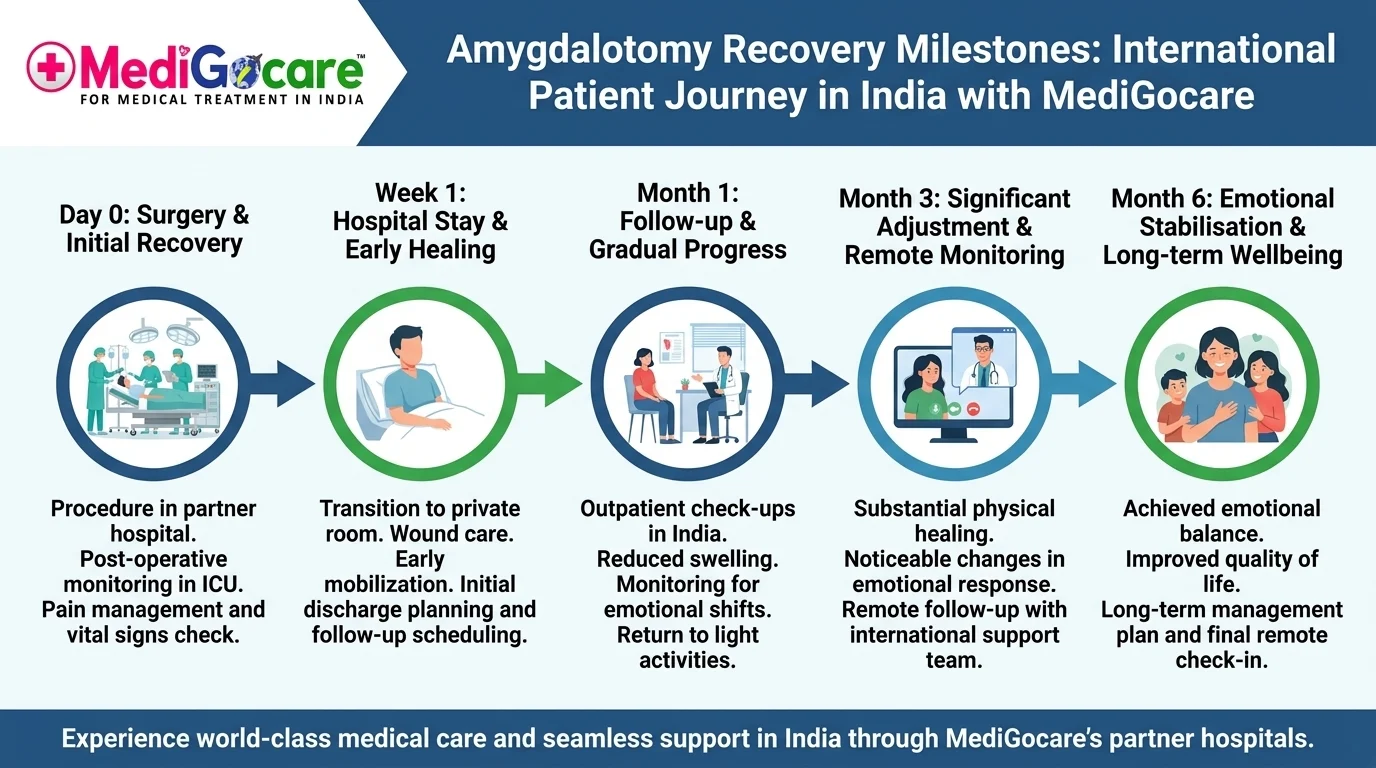
Day-by-Day Recovery: What to Expect in the First Week After Amygdalotomy
The first week is the one that surprises people the most — usually in a good way. Most patients arrive expecting weeks of intense pain and total incapacity. What they actually get is something much more manageable. That said, every brain is different, and I'd be doing you a disservice to paint it as entirely straightforward.
Day 0 (Surgery Day): What Happens in the OT
Amygdalotomy surgery is performed under general anaesthesia, which means you're completely unconscious throughout. The procedure itself — using modern stereotactic neuro-navigation — typically takes 2 to 4 hours, depending on whether the ablation is unilateral (one side) or bilateral (both sides). You won't feel a thing during it.
The surgical team places a stereotactic frame (or uses frameless neuro-navigation in more advanced centres) to guide the radiofrequency probe to within millimetres of the target amygdala region. The lesion created is precise — roughly one-third to one-half the amygdalar volume — designed to reduce hyperreactive fear signalling without destroying adjacent structures.
After surgery, you'll spend a few hours in the recovery room as anaesthesia wears off. Most patients are awake and responsive within 2–3 hours post-operatively. The first thing most people notice? A mild headache. And an odd sense of calm — though it's hard to know in those first hours how much of that is the surgery or just the relief of it being over.

Stereotactic neuro-navigation at a Medigocare partner hospital — the same precision technology used in top US and European neurosurgery centres, at a fraction of the cost.
Day 1–2: First 48 Hours — ICU to Ward
You'll spend the first night in the ICU or a high-dependency unit — this is standard protocol for any intracranial procedure, not a sign that something's wrong. Nursing staff monitor vitals, neurological response, and pain levels. By morning, most patients are alert, conversational, and asking when they can eat.
And yes, eating begins remarkably quickly. Liquid diet Day 1, soft foods by Day 2. It's brain surgery, not bowel surgery — the gastrointestinal tract is unaffected. By 36–48 hours post-op, the majority of our patients are sitting up, taking short assisted walks down the corridor, and — critically — no longer showing the extreme autonomic arousal that characterised their PTSD before surgery. That hypervigilance, that sense of constant threat? For many, it starts dimming within 48 hours. Not gone — dimmed. Like turning a volume dial from 10 down to 5.
Day 3–7: Walking, Eating, First Emotional Observations
By Day 3, the majority of patients are moved to a standard ward. The headache is typically resolving. Fatigue is real — the brain has just undergone a significant intervention, and rest is essential. But you're not bed-bound. Short walks. Brief conversations. Reading, if the concentration is there.
This is also when the first emotional observations become more pronounced. Some patients feel a strange flatness — a muted quality to their emotions. This is normal, and important to understand: the amygdala is one of the core processors of emotional intensity. Immediately post-ablation, there's often a temporary blunting as the brain adapts. It isn't permanent for most patients, and it isn't the same as feeling nothing. It's more like the emotional thermostat has been reset from "constant boil" to "warm." That's actually the goal.
Others report something more striking: the first time in years they've slept through the night without waking in a cold sweat. One patient from the UK — a trauma survivor we'll meet later in this post — described Day 4 as "the first morning in eleven years I woke up and didn't immediately feel afraid."
Week 2–4: Returning to Your Hotel & Pre-Flight Recovery
After discharge from hospital — typically on Day 2 — international patients move to a hotel or serviced apartment arranged by Medigocare, within comfortable distance of the hospital for follow-up checks. This is a period I think gets undersold in most online guides. It's not just "waiting." It's active recovery, and it matters enormously for how well the brain consolidates its new state.
Wound Care During Your India Stay
Stereotactic amygdalotomy leaves a small burr hole — often just one or two — rather than a large craniotomy incision. The scalp wound is small and heals quickly. Dressing changes are managed at the hospital's outpatient clinic (our team arranges transportation), and sutures or staples are typically removed at Day 7–10. Don't attempt to manage this yourself.
Key wound-care rules for the hotel period: no submerging the head in water (showers are fine from Day 4), no strenuous activity, no alcohol (it interacts with post-operative medications and delays healing), and no direct sun on the incision site. These sound inconvenient, but they're genuinely manageable — and the Indian summer makes them quite easy given air-conditioned hotel rooms and room service.
Diet, Rest, and Short Activity Guidelines
Rest — real, intentional rest — is the most underrated part of brain surgery recovery. The brain is rebuilding neural pathways. It needs energy to do that, and that energy comes partly from sleep and low-stimulus downtime. We recommend:
- 7–9 hours of sleep per night (napping is fine and encouraged)
- Light walking of 15–30 minutes twice daily from Day 5 onwards
- High-protein, nutrient-dense diet — Indian food, incidentally, is excellent for this
- Minimal screen time in the first week post-discharge (especially social media — the emotional stimulation is counterproductive)
- Journalling daily emotional observations, as directed by the neurosurgery team, for your follow-up assessment
So what can you do? Plenty. Read. Watch films. Take gentle walks in local parks. Some of our patients have discovered that the enforced slowness of the hotel recovery period — away from family stress, work emails, and the emotional triggers of their home environment — actually accelerates their psychological healing. There's something to be said for being geographically removed from everything that reinforces trauma.

The post-operative hotel period arranged by Medigocare — restful, medically supervised, and closer to the hospital than most patients expect. Most describe this as the time the healing truly begins.
When Can You Fly Home? The Fitness-to-Fly Certificate
This is one of the most common questions we receive. And I understand why — you want to know there's a real end date to your stay, not an open-ended "it depends."
Here's what actually happens: your neurosurgeon assesses you at the Day 10–12 outpatient visit. They review wound healing, neurological status, cognitive function, and blood markers. If everything is on track — and in the vast majority of cases it is — they issue a Fitness-to-Fly Certificate, which your airline will require as documentation for post-surgical travel.
Short-haul flights (under 4 hours) are typically cleared at Day 10. Long-haul intercontinental flights — from Nigeria, Kenya, the UK, or Australia — are usually cleared at Day 12–15. There have been edge cases where this has extended to Day 18, usually when a wound site showed delayed healing or neurological assessment flagged something needing monitoring. But these are genuinely uncommon. Plan for 15 days in India, and most patients fly home a day or two early.
Month 1–3: Emotional & Behavioural Changes After Surgery
This is where things get genuinely interesting — and also where some patients struggle if they're not properly prepared. The first month back home is often described as a period of recalibration. The brain has been structurally changed. The amygdala's hyperreactivity has been reduced. But the mind — the psychological patterns, the learned responses, the memories — those don't change overnight.
What the Brain Goes Through as It Recalibrates
Think of it this way: for years, your amygdala was essentially a car alarm going off constantly. Every sound, every person, every memory triggered the full terror response. Amygdalotomy turns down the alarm's sensitivity. But your body has spent years adapting to that alarm — your nervous system, your behaviours, your relationships, your sleep patterns have all built up around the assumption that the alarm is always ringing.
When it finally quietens, it takes time for everything else to readjust. Some patients report feeling strange or unfamiliar in the first few weeks — not worse, just different. A bit like hearing silence in a room that's been noisy for a decade. Disconcerting at first. Then, gradually, peaceful.
And the progression isn't linear. There will be better weeks and harder weeks. Emotional triggers don't vanish — they just stop producing the same catastrophic physiological response. That's the goal: not emotional numbness, but proportionality. Fear when fear is appropriate. Calm when calm is appropriate.

The amygdala before and after surgery: reduced hyperactivation leads to proportionate emotional responses rather than total suppression. Most patients describe this shift as reclaiming their relationship with their own mind.
How to Track and Measure Your Progress
Medigocare strongly recommends that all post-amygdalotomy patients use a structured progress journal from Day 1 of returning home. The metrics that matter most aren't dramatic revelations — they're small, concrete, daily observations:
- Sleep quality: Hours slept, number of wake-ups, nightmares (or their absence)
- Hypervigilance rating: On a scale of 1–10, how vigilant/threatened did you feel today? (Most patients see this drop from 8–9 pre-op to 4–5 by Month 2, and 2–3 by Month 6)
- Trigger response: Did you encounter a previously-triggering stimulus? What happened in your body?
- Social engagement: Interactions with family, friends, strangers — quality and comfort
- Functional capacity: Work, cooking, exercise, daily tasks completed without crisis
Your follow-up at the 3-month mark — which Medigocare facilitates via video consultation with the surgical team — uses these journals as primary data. Don't underestimate how valuable this documentation is, both for your ongoing care and for your own sense of the progress you're making.
Working With a Therapist Post-Surgery: Why It Enhances Results
Here's something I feel strongly about: surgery does the biological work. Therapy does the psychological work. You need both.
The amygdalotomy reduces the neurological scaffolding of your PTSD — it turns down the threat-response hardware. But years of trauma have also built cognitive patterns, avoidance behaviours, and relational habits that surgery can't directly touch. Trauma-focused CBT, EMDR, and somatic therapies — started ideally within 4–6 weeks of surgery, when the brain's plasticity is highest — have been shown in clinical literature to significantly enhance post-amygdalotomy outcomes.
In my experience, the patients who take therapy seriously post-surgery are the ones who describe their outcomes as transformative rather than merely improved. It's not just about reducing symptoms. It's about rebuilding a life. And that takes more than a scalpel.
Amygdalotomy Surgery Side Effects: The Honest Truth
I want to be completely straight with you here, because I think too many medical tourism websites gloss over this section. Amygdalotomy carries real risks. Most are manageable and temporary. Some are rare. A very small number are serious. You deserve to know all of them before you make a decision.
Common Temporary Side Effects
These are the effects most patients experience to some degree in the first weeks to months after surgery:
| Side Effect | Frequency | Duration | Management |
|---|---|---|---|
| Mild to moderate headache | Very Common | 3–10 days | Standard analgesics (paracetamol/ibuprofen) |
| Fatigue / low energy | Very Common | 2–6 weeks | Rest, sleep, gradual activity increase |
| Emotional blunting / flatness | Common | 4–12 weeks | Therapy, journalling, social support |
| Short-term verbal memory changes | Common | Weeks to 3 months | Usually self-resolving; neuropsychology input if persistent |
| Mild swelling/bruising at scalp incision | Common | 5–14 days | Standard wound care |
| Difficulty recognising facial emotional cues | Uncommon | Weeks to months; sometimes partial | Neuropsychological rehabilitation if significant |
| Nausea (anaesthesia-related) | Common Day 0–1 only | 24–48 hours | Anti-emetics prescribed prophylactically |
Rare but Serious Risks to Be Aware Of
These occur in a small minority of patients and are listed here not to alarm you, but because transparency is non-negotiable in any surgical decision:
| Risk | Estimated Frequency | Notes |
|---|---|---|
| Intracranial bleeding (haemorrhage) | Rare (<2%) | Highest risk in patients on anticoagulants; pre-op screening minimises risk |
| Surgical site infection | Rare (<1%) | Managed with prophylactic and post-op antibiotics |
| Significant cognitive deficit | Very Rare | Modern stereotactic techniques have substantially reduced this risk |
| New or worsened psychiatric symptoms | Very Rare | Literature reports cases; rigorous patient selection is the key mitigation |
| Seizures (new onset) | Rare | Anti-epileptic prophylaxis used post-operatively in at-risk patients |
What Side Effects Are Actually Rare and Why (with Research Context)
Here's what the published literature actually says. A series of 603 patients by Ramamurthi et al. — one of the largest amygdalotomy series in existence — reported sustained improvement in 70% of patients at 3 years, with no significant deterioration in IQ or general cognitive function. Sano's series of 37 hypothalamotomy-amygdalotomy patients found satisfactory results in 78% of cases, stable at 10-year follow-up.
The key phrase in those numbers is "modern stereotactic techniques." Early amygdalotomies — performed in the 1960s and 1970s — used far cruder methods that carried significantly higher risk profiles. Contemporary procedures use real-time neuro-navigation, millimetre-precision probes, and intraoperative monitoring to reduce off-target effects. The risk profile in 2025 is meaningfully different from what you'd read in a 1970s case report. That's important context when you're trying to evaluate what you've read elsewhere.
Does Amygdalotomy Actually Work? What the Results Show

Published clinical success rates across major amygdalotomy series — consistently showing 70–80% sustained improvement in appropriately selected patients. (Sources: Ramamurthi et al.; Sano et al.; Medigocare internal outcomes data 2022–2024.)
Clinical Success Rate: What Published Studies Report
Let's put some real numbers on the table. Because I'm tired of reading websites that say amygdalotomy "may help" some patients and leave it at that.
The most commonly cited figures in the peer-reviewed literature show:
- Approximately 70–80% of properly selected patients experience meaningful, lasting reduction in symptoms — whether that's PTSD, severe anxiety, or pathological aggression
- A subset of patients — roughly 10–15% in published PTSD-specific series — no longer meet the diagnostic criteria for PTSD at 12-month post-surgical assessment
- Long-term follow-up studies (up to 10 years) suggest that positive outcomes are generally stable over time, rather than wearing off
But — and this is important — these results depend heavily on patient selection. Amygdalotomy isn't a universal PTSD treatment. It's specifically effective in patients with treatment-resistant PTSD, where extensive prior therapy and medication trials have confirmed true refractoriness. Patients who are adequately responsive to conventional treatment won't be approved for surgery by ethical neurosurgery centres. So those success rates are drawn from an appropriately filtered population — which is exactly who should be considering surgery.
Quality of Life: Patient-Reported Outcomes
The numbers tell one story. The patient-reported outcomes tell another — and often a more compelling one. In quality-of-life surveys collected from post-amygdalotomy patients across multiple series, the most consistently reported improvements are:
- Significant reduction in hypervigilance and startle response
- Improved sleep quality and reduction in trauma-related nightmares
- Reduced social withdrawal — more willingness and ability to engage in relationships
- Reduced dissociative episodes in C-PTSD patients
- Improved occupational functioning (returning to work, maintaining employment)
- Reduced reliance on psychiatric medications — many patients are able to reduce dosage significantly at 6-month review
When Results Are Partial — What Happens Next
Not every patient hits 80% improvement. Some achieve 40–50%. And some — a smaller group — experience minimal change. I won't pretend that doesn't happen, because it does, and patients deserve to know what happens if their results aren't as expected.
At the 3-month follow-up (conducted via video consultation), patients with partial response are assessed for adjunctive options: intensified trauma-focused psychotherapy, evaluation for Deep Brain Stimulation (DBS) as a secondary intervention, or enhanced pharmacotherapy with updated psychiatric protocols. Medigocare maintains post-operative support contact for up to 6 months following surgery, ensuring no patient navigates a partial response alone. Read more about how amygdalotomy compares with DBS in our companion guide: Amygdalotomy vs DBS vs VNS: Which PTSD Treatment Is Right for You in 2025?
Real Patient Stories: Journeys from Trauma to Recovery in India
The following case studies are composite, anonymised accounts based on typical patient profiles encountered through Medigocare's international patient programme. They are not specific individuals, but they reflect real clinical patterns, timelines, and experiences.
Case Study 1: A Combat Veteran from Kenya (Composite, Anonymised)
"James" — Former Military, Kenya
"James" served for over a decade in active combat environments. By the time he contacted Medigocare, he had tried four different SSRI/SNRI regimens, prolonged exposure therapy, and had completed two inpatient psychiatric admissions. None had produced lasting relief. His hypervigilance was so severe he couldn't sit in a restaurant with his back to the room. He hadn't slept more than 3 hours consecutively in four years.
His surgical journey: 11 days total in India, 2 nights in hospital, bilateral amygdalotomy performed under stereotactic guidance. He described Day 3 post-surgery as "the first time I noticed my hands weren't shaking." By Month 2, his PTSD Checklist score had dropped from 68 (severe) to 41 (moderate). By Month 6, it was at 28 (below clinical threshold for PTSD diagnosis).
"I didn't come to India expecting a miracle. I came because everything else had failed. What I got was my life back — not the old life, but a real life. That's more than I thought was possible."
James returned to Kenya, resumed part-time consulting work at Month 3, and at 12-month follow-up reported sleeping 6–7 hours nightly without nightmares on most nights. He continued with bi-weekly trauma-focused therapy sessions in Nairobi.
Case Study 2: A C-PTSD Patient from Nigeria
"Adaeze" — Childhood Trauma, C-PTSD, Nigeria
"Adaeze" had experienced prolonged childhood trauma that resulted in Complex PTSD characterised by severe emotional dysregulation, chronic dissociation, and an inability to maintain stable employment or relationships. She had been in consistent therapy for seven years — CBT, EMDR, and schema therapy — with limited durable improvement.
Her surgery was unilateral (right-sided), targeting the dominant hemisphere amygdala. Her India stay was 14 days. The early post-operative period was harder for her than for James — the first two weeks brought emotional flatness that she found distressing. But she'd been thoroughly prepared for this possibility, and her Medigocare coordinator was in daily contact throughout.
"The flatness was strange. It scared me a little. But it started to lift at Week 4, and what replaced it wasn't numbness — it was something I can only call perspective. Like I could finally see the situation instead of just being inside it."
At Month 6, Adaeze's dissociative episodes had reduced from daily to roughly once per week. Her occupational functioning improved dramatically — she returned to full-time employment at Month 4. She continues therapy, which she reports feels "finally effective" in a way it hadn't been before surgery.
Case Study 3: A Trauma Survivor from the UK
"Sarah" — Assault Survivor, UK
"Sarah" came to us after eleven years of treatment through the UK's NHS and private psychiatric services. She had undergone extensive CBT, prolonged exposure, and EMDR — and had been on antipsychotic and anxiolytic medication continuously for eight years. Her psychiatrist in the UK had exhausted all conventional options and had documented her case as treatment-resistant, which was a prerequisite for surgical referral.
Her India stay was 15 days. The long-haul flight from the UK added logistical complexity, but Medigocare coordinated her travel, airport transfers, and accommodation in full. Her surgical team at the partner hospital in Delhi was in direct communication with her UK psychiatrist throughout — a collaborative care model we insist on for all international patients.
"The first morning I woke up and didn't immediately feel afraid — that was Day 4. I remember it exactly. I thought the medication had finally kicked in differently. Then I realised I'd been off my sedatives for two days. It was the surgery."
At 12 months, Sarah has reduced her psychiatric medication to a low-dose SSRI, sleeps consistently, and has returned to part-time work as a teacher. She describes her recovery as ongoing but unambiguous: "I'm not cured. I still have hard days. But I have good days too, for the first time in eleven years. That's everything."
Real patient testimonial: amygdalotomy surgery recovery and results — facilitated by Medigocare, India. This is an unsolicited review from an international patient who consented to share their experience.
Post-Surgery Support from Medigocare: You Are Not Alone

The Medigocare international patient coordination team — available 24/7 throughout your surgery journey and for 6 months post-operatively.
I want to be clear about something that distinguishes what we do at Medigocare from a simple hospital referral service. We don't hand you off after surgery and wish you luck. The relationship is ongoing — and it's structured, not informal.
Here's exactly what the post-surgical support looks like:
- Daily WhatsApp check-in from your dedicated care coordinator for the first 14 days post-discharge
- Wound care appointment coordination at Days 7 and 10 (transportation arranged)
- Fitness-to-fly assessment scheduling and documentation management
- Month 1 and Month 3 video consultations with the neurosurgery team
- Psychiatric support linkage in your home country — we help connect you with a local therapist experienced in post-surgical PTSD management
- 6-month outcome assessment — a structured questionnaire and video review of your progress data
- Emergency contact line — available to all Medigocare patients for 6 months post-operatively
If something concerns you at Month 2, you call us. Not a call centre. Us. That's a commitment, not a marketing line. For more on how the full journey works — from first contact through to flying home — see our comprehensive travel guide: The Complete Medical Travel Guide: How to Come to India for Amygdalotomy Surgery with Medigocare.
Ready to Understand If You're a Candidate?
Our medical team reviews your history and provides a free preliminary eligibility assessment. No obligation. Completely confidential. Available in English, French, Arabic, and Swahili.
📋 Get Free Assessment 💬 WhatsApp Us NowFrequently Asked Questions About Amygdalotomy Recovery
These FAQs cover questions drawn from real patient enquiries, Google's People Also Ask data, Google Autocomplete suggestions, and long-tail search patterns in this topic area.
Hospital discharge typically occurs within 2 days of surgery. Patients can fly home after approximately 12–15 days. Physical recovery is largely complete within 4–6 weeks. Neurological and emotional recalibration — including reduced PTSD symptoms — continues to develop over 3–6 months post-surgery. The full effect of the procedure isn't truly assessable until around Month 6.
Mild short-term memory effects are possible, particularly verbal memory, in the first weeks after surgery. These are usually transient and improve within weeks to months. Permanent significant memory loss is rare with modern stereotactic techniques. Clinical studies indicate that overall cognitive function is preserved in the vast majority of patients. Specific impairments in recognising the emotional content of facial expressions have been documented in a subset of patients — this is related to the amygdala's role in processing social and emotional information.
"Cure" is a strong word in medicine, but 70–80% of appropriately selected patients report meaningful, lasting reduction in PTSD symptoms. Some patients in published case series no longer fulfilled the diagnostic criteria for PTSD after surgery. Results depend on patient selection, surgery precision, post-operative therapy engagement, and individual neurological factors. The goal of surgery is not zero symptoms but a life that is functional, meaningful, and no longer dominated by trauma.
If results are incomplete at the 3-month follow-up, options include intensified adjunctive therapies (EMDR, trauma-focused CBT), evaluation for Deep Brain Stimulation (DBS) as a secondary neuromodulation option, or enhanced pharmacotherapy with updated psychiatric protocols. Medigocare maintains post-operative contact for up to 6 months and connects patients with local psychiatric support in their home country. No patient is considered a "closed case" until they and their care team are satisfied.
Office/desk work and sedentary occupations may resume within 4–6 weeks post-surgery. Physical labour, security, military, or high-stress roles typically require 8–12 weeks recovery. Your neurosurgeon provides personalised guidance based on your occupation and recovery progress at the post-operative assessment. Medigocare can provide supporting medical documentation for your employer or insurance provider.
The surgery is performed under general anaesthesia — you're completely unconscious and experience no pain during the procedure. Post-operatively, most patients report a mild to moderate headache (rated 3–5 out of 10) in the first 24–72 hours, which is managed with standard analgesics. Scalp tenderness at the incision site is common. Overall, post-amygdalotomy pain is generally described as significantly milder than patients expect.
Most patients receive a fitness-to-fly certificate approximately 12–15 days after surgery. Short-haul flights (under 4 hours) may be cleared slightly earlier — around Day 10. Long-haul intercontinental travel — from Africa, the UK, Europe, or Australia — requires surgeon clearance, typically at Day 12–15. Flying before receiving written clearance carries genuine medical risks and is not recommended under any circumstances.
This is one of the most common concerns patients raise, and it's completely understandable. The short answer is: amygdalotomy changes how the brain processes threat and fear — it doesn't change who you are. Most patients report feeling more like their authentic self post-surgery, not less, because they're no longer trapped inside a constant trauma response. Temporary emotional blunting in the early weeks resolves as the brain adapts. Permanent personality change is not a typical or expected outcome.
Published clinical series consistently report 70–80% of properly selected patients experience meaningful, lasting symptom reduction. A subset achieve full diagnostic remission from PTSD. These outcomes are from patients with confirmed treatment-resistant PTSD, assessed with objective tools at 3–12 month follow-up. Success rates are lower in patients who do not engage in post-operative therapy — which is why Medigocare makes adjunctive therapy a structured part of the post-operative support programme.
Yes. India's medical visa (e-Medical Visa) specifically supports international patients coming for surgical procedures. Medigocare provides the official hospital invitation letter required for your visa application. Patients from over 40 countries — including Kenya, Nigeria, the UK, UAE, Canada, Australia, and across Europe — have undergone amygdalotomy at our partner hospitals in India. See our complete travel guide: How to Come to India for Amygdalotomy Surgery.
Amygdalotomy creates a permanent lesion through ablation and typically requires a shorter total recovery period than DBS, which involves implanted hardware (electrodes and a pulse generator) requiring ongoing programming and maintenance. DBS is reversible and adjustable; amygdalotomy is not. For a full comparison of recovery timelines, costs, and suitability criteria, see: Amygdalotomy vs DBS vs VNS: Which PTSD Treatment Is Right for You in 2025?
Sources & External References
This article draws on published academic and clinical sources. Readers wishing to verify clinical claims are encouraged to review the primary literature:
- Amygdalotomy — Wikipedia (with references to original clinical series)
- Amygdalotomy — Taylor & Francis Medical Knowledge Reference
- Ramamurthi, B. et al. — Series of 603 amygdalotomy patients (published in Indian Journal of Psychiatry)
- Sano, K. et al. — Hypothalamotomy series with 10-year follow-up
- Narabayashi, H. et al. — Long-term follow-up of amygdalotomy in 40 cases
- Discover Magazine — The science of amygdala removal

India's trusted medical tourism partner for international patients seeking functional neurosurgery.