24/7 Customer Assistance
24/7 Assistance with the best medical care at your service

Call us for any question
+91 90858 83067BLOCK-B, PH-1, Sushant Lok Phase I, Gurugram, Haryana 122001
IndiaOffice Hour: 09:00am - 09:00pm
info@medigocare.com
Let me be honest with you. When I first started speaking with patients who'd spent months — sometimes years — trying to access amygdalotomy surgery through their home country's healthcare system, the numbers they quoted me were genuinely shocking. A family from California told me their neurologist's estimate came in at just over USD 90,000, excluding post-operative rehabilitation. A patient from Manchester said the NHS had flatly declined to fund it, and a private quote was pushing £65,000. Both of them found Medigocare, came to India, and had the surgery done for under USD 11,500, all in.
So this blog isn't about convincing you India is some discount healthcare destination. It's about breaking down exactly why amygdalotomy surgery cost in India is what it is — line by line, number by number — so you can make the most informed decision of your life.
Amygdalotomy is a functional neurosurgery procedure. It's not a hip replacement. There's no insurance code that cleanly maps to it in most Western markets, and it's still classified as "experimental" or "investigational" by most US and UK insurers — which means the full cost lands squarely on the patient.
And that's before you even factor in the surgical scarcity. The number of surgeons in the USA actively performing stereotactic amygdalotomy for PTSD and refractory psychiatric conditions is tiny. When supply is restricted and demand is desperate, prices climb to places that have nothing to do with what the surgery actually costs to perform.
In the United States, a single neurosurgical procedure involving a stereotactic frame, intraoperative MRI, and ICU monitoring can rack up costs fast. The hospital facility fee alone for a related procedure (amygdalohippocampectomy) runs a median USD 8,000 just for the operating room charges — and the surgeon's fee, anesthesia, neuronavigation, ICU, and follow-up are all billed separately. By the time you've added those layers plus malpractice insurance premiums embedded into every single billing code, the total easily clears USD 50,000 to USD 100,000.
And here's the thing that really stings: if your insurer calls it experimental, not one dollar of that is covered. You're paying out of pocket, in full, upfront.
The NHS does extraordinary things within its constraints. But amygdalotomy for refractory PTSD isn't on the approved procedures list. The NHS's Clinical Commissioning Groups won't fund procedures without a robust body of large-scale randomised controlled trial data — and the evidence base for amygdalotomy, while genuinely promising, hasn't reached that bar yet in most psychiatric indications.
Private healthcare in the UK is an option, but at £40,000–80,000, it's a second mortgage for most families. Add to that a typical 3–12 month wait even for private referrals through the correct neurosurgical channels, and it becomes a genuinely impossible situation for people in crisis.
Canada's publicly funded healthcare system is similarly conservative. The procedure is often listed as simply "unavailable via public health" — meaning patients are either turned away or told to seek surgery abroad. Australia faces comparable access issues, with costs in the private sector running AUD 45,000–90,000. Wait times in both countries routinely stretch 6–18 months even for initial specialist consultations.
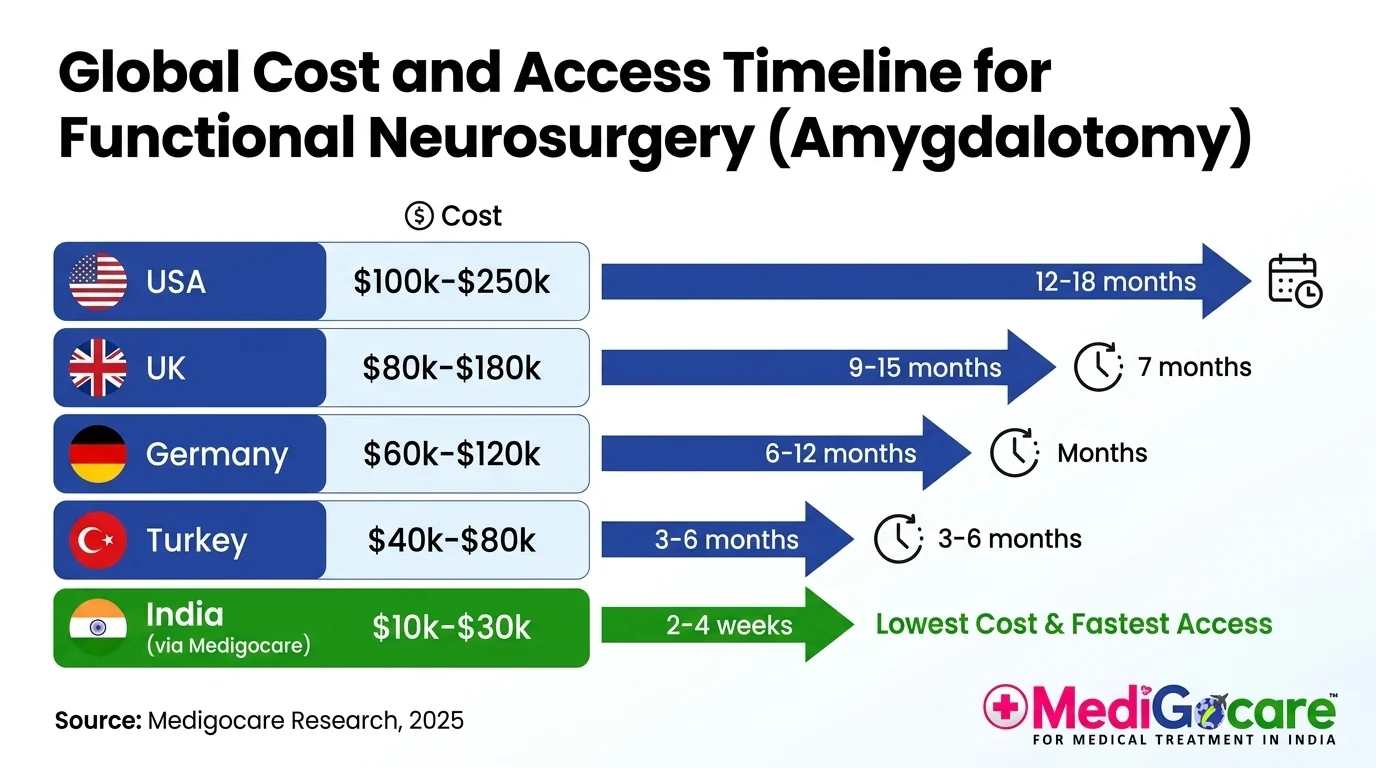
Below is the most comprehensive country-by-country comparison for amygdalotomy surgery cost and functional neurosurgery pricing we've been able to compile. These figures are based on Medigocare's own patient data, published hospital price transparency reports, and direct surgeon consultations across markets.

| Country | Amygdalotomy / Functional Neurosurgery Cost (USD) | Insurance Coverage | Typical Wait Time for Surgery |
|---|---|---|---|
| USA | $50,000 – $100,000+ | Almost never (experimental classification) | 6–18 months |
| UK (Private) | $40,000 – $80,000 | Not covered by NHS; private only | 3–12 months (referral required) |
| Germany | $35,000 – $70,000 | Rarely covered; case-by-case basis | 6–12 months |
| Australia | $30,000 – $60,000 | Medicare rebate minimal; gap large | 6–18 months |
| Canada | $35,000 – $80,000 | Often unavailable via public health | Often unavailable or undefined |
| Thailand | $15,000 – $25,000 | Self-pay only; limited surgical expertise | 2–4 weeks |
| India (via Medigocare) | $9,000 – $12,000 (all-inclusive) | Self-pay; full package transparency | 7–21 days from booking |
The sticker price in Western countries is only the beginning. In my experience working with international patients, the final bill in the USA or UK always exceeds initial estimates — sometimes by 30–40%. Here's where the hidden layers live:
Pre-surgical neuropsychiatric evaluations are typically billed separately, often USD 2,000–5,000. Neuronavigation and intraoperative imaging add another USD 8,000–15,000 on top of basic OR fees. ICU monitoring for even one night in a US hospital runs USD 3,000–6,000 per day. And if there's any complication — however minor — the bill can double overnight. None of this is speculative; it's what our patients tell us after going through the Western healthcare quoting process.
People always ask me: "But what's actually included?" It's the right question. One of the most frustrating things about Western surgical pricing is the deliberate opacity — you never quite know what you're paying for until the bill arrives. We don't operate that way.
* Final price depends on hospital tier, surgeon's experience level, and individual clinical complexity. All pricing confirmed in writing before you commit to anything.
We're upfront about this because it matters. International airfare is not included — expect USD 800–2,500 depending on your origin country. Accommodation outside the hospital (we recommend 7–10 additional days for recovery before flying) runs USD 35–90 per night at comfortable partner-approved hotels near our hospital partners in Delhi or Gurugram. Post-operative medications after discharge are an additional USD 100–250. And of course, visa and travel insurance are your responsibility — though we'll provide the hospital invitation letter for your medical visa application at no charge.
This is the question I get more than any other. And it's fair — 70% is a staggering number. People assume there must be a catch. There isn't. But there are four very real, very logical structural reasons why amygdalotomy surgery is affordable in India without any clinical compromise.

Running a neurosurgical suite in Gurugram costs a fraction of running an equivalent facility in Houston or London. Staff salaries, facility overheads, energy costs, supply chain logistics — every single input cost is structurally lower in India. This isn't about cutting corners; it's simply a different economic baseline. The Leksell stereotactic frame used in Indian hospitals is the same device used at Massachusetts General. The difference is what it costs to have a scrub nurse in the room.
The USD-INR exchange rate is, for Western patients, an extraordinary structural tailwind. One US dollar buys roughly 83–84 Indian rupees as of early 2025. A surgeon who earns an excellent, senior-level income in India in rupee terms receives, in dollar terms, a salary that looks modest by US standards. That savings flows directly to you. It's not a charity — it's macroeconomics working in your favour.
This one surprises people. In the USA, neurosurgeons pay malpractice insurance premiums that can run USD 100,000–200,000 per year. That cost is baked into every billing code, every procedure, every consultation. India's litigation environment is markedly different — malpractice premiums are a fraction of US levels, and that difference gets passed through to the patient's bill.
India's top medical institutions — AIIMS (All India Institute of Medical Sciences), NIMHANS, PGI Chandigarh — are government-funded. The neurosurgeons training there aren't graduating with USD 400,000 in medical school debt. They don't need to charge extraordinary fees simply to service their student loans. The result is a pool of world-class surgical talent who can offer globally competitive outcomes at locally affordable rates.
Most international patients should plan for roughly 15–21 days in India total. Here's a realistic budget frame for a solo patient flying from the USA or UK, staying in comfortable (not luxury) accommodation near our hospital partners in Gurugram or Delhi:
| Expense Item | Low Estimate (USD) | High Estimate (USD) | Notes |
|---|---|---|---|
| Surgery Package (Medigocare) | $9,000 | $12,000 | All-inclusive (see breakdown above) |
| Return Airfare (from USA/UK) | $800 | $2,500 | Economy; book 4–6 weeks ahead |
| Accommodation (12 nights post-hospital) | $420 | $1,080 | USD 35–90/night; Medigocare partner hotels |
| Local Transport (Uber/cab) | $80 | $200 | Very affordable in Delhi NCR |
| Food & Daily Living | $200 | $500 | India is very affordable for food |
| Post-Surgery Medications (discharge) | $100 | $250 | Brand/generic options available |
| Medical Visa + Travel Insurance | $150 | $400 | Medigocare provides hospital invitation letter |
| TOTAL TRIP BUDGET | $10,750 | $16,930 | Vs. $50,000–$100,000+ in the USA |
Book your flights early — Medigocare can give you a provisional surgery date within 48–72 hours of your initial consultation, which gives you time to find good airfare. Don't bring a companion unless you genuinely need one; while the support is valuable, the extra flight and accommodation cost adds up. And don't try to rush the post-operative recovery period to save on accommodation — that's not a corner worth cutting when you've just had brain surgery.
Real patient testimony: Amygdalotomy surgery in India through Medigocare — cost, experience, recovery. (YouTube, shared with patient consent)
Let me say this plainly: the quality gap between a top-tier Indian hospital and an equivalent American or British centre is, for functional neurosurgery, essentially zero. That's not marketing language — it's a conclusion supported by the technology in use, the surgeon training pathways, and the published clinical outcomes.

NABH (National Accreditation Board for Hospitals & Healthcare Providers) is India's equivalent of The Joint Commission in the USA. JCI (Joint Commission International) is the global gold standard — the same body that accredits premier hospitals in Singapore, Dubai, and Brazil. Medigocare exclusively partners with hospitals holding both NABH and JCI certification. That's not a nice-to-have. It's a non-negotiable standard that tells you these facilities have passed rigorous external inspection across every clinical and safety metric.
Our primary neurosurgical partner, Fortis Memorial Research Institute in Gurugram, is the home institution of Dr. Rana Patir — a neurosurgeon with over 10,000 successful procedures and an MCh from AIIMS New Delhi. That's not a surgeon you'd find at a cut-rate facility. That's the kind of surgeon whose operating theatre waiting list in the USA would cost you USD 80,000 to access.
When it comes to the actual tools used in the OR, India's top centres are using identical hardware to their Western counterparts. Leksell Gamma Knife systems, Brainlab neuronavigation platforms, intraoperative MRI capability, LITT (Laser Interstitial Thermal Therapy) units — these aren't inferior Indian versions of Western technology. They are the same devices, bought from the same manufacturers, programmed by the same software, and operated by surgeons trained in some cases at the same international fellowship programmes.
India has one of the world's longest clinical track records in stereotactic functional neurosurgery. NIMHANS Bangalore and AIIMS New Delhi have published peer-reviewed research on amygdalotomy outcomes dating back decades — a depth of institutional experience that most Western centres simply don't have, because the procedure is rarely performed there.
Yes — and in my honest assessment, in some ways it's even better, at least in terms of accumulated stereotactic experience. India's top neurosurgery hospitals (Apollo, Fortis, Medanta) use identical neuronavigation and LITT technology as leading US centres. Indian neurosurgeons trained at AIIMS and internationally recognised institutions match global standards. NIMHANS Bangalore alone has decades of published clinical experience with functional neurosurgery that most Western institutions can't match simply because amygdalotomy is performed so rarely in the USA and UK. The outcomes are equivalent — the price is not.
India's lower surgical costs are driven by four structural factors: lower operational costs (staff salaries, facility overheads), no excessive malpractice litigation premiums embedded in billing codes, government-subsidised medical education producing world-class talent without crippling student debt, and a favourable USD-INR exchange rate. None of these factors compromise clinical quality. They simply reflect a different economic environment — one that happens to work significantly in your favour as an international patient.
Most Western insurance policies don't cover amygdalotomy anywhere — including in India — because it's still classified as experimental psychiatric neurosurgery by most payers. Patients travelling to India typically self-pay. Some repatriation or travel health insurance policies may cover emergency follow-up care if complications arise after returning home. Medigocare strongly advises checking with your insurer before travelling and will provide whatever documentation they need from the hospital side to support your query.
The package includes: surgeon and assistant fees, OT charges, general anaesthesia, ICU monitoring (first night post-surgery), hospital stay (2 nights in a private room), all pre-surgery diagnostics including MRI brain mapping and neuronavigation planning, post-surgery medication during hospital stay, nursing care, hospital-to-airport transfer, and 24/7 Medigocare case management support. Travel, accommodation outside the hospital, and airfare are additional.
Medigocare works with patients to create flexible payment arrangements where possible. A deposit secures your hospital booking and surgeon consultation. The balance is typically settled before the procedure begins. Payment schedules are discussed on a case-by-case basis — contact our team via WhatsApp (+91 9085883067) or the website contact form to discuss your specific situation.
Most international patients plan a 14–21 day trip. The breakdown is typically: 3–5 days for pre-surgical neuropsychiatric evaluation and imaging, 1 day of surgery plus 2 nights hospital stay, and 7–10 additional days of post-operative monitoring and recovery before the flight home. Returning home too early — within 5–7 days of surgery — significantly increases the risk of complications on a long-haul flight.
Medigocare works with JCI and NABH-accredited hospitals including Fortis Memorial Research Institute (Gurugram), Apollo Hospitals (Delhi and Hyderabad), and Medanta – The Medicity (Gurugram). All three are equipped with advanced neuronavigation suites, Leksell stereotactic systems, and experienced functional neurosurgery teams. Your assigned hospital will depend on your clinical profile, the surgeon's recommendation, and availability at the time of booking.
Yes. Stereotactic amygdalotomy is legally performed in India under strict multi-disciplinary evaluation protocols — typically involving a psychiatrist, neurologist, and neurosurgeon before any patient is cleared for surgery. India has one of the longest clinical histories with functional neurosurgery in Asia, with institutions like NIMHANS Bangalore publishing peer-reviewed research on the procedure spanning several decades. It's one of the most experienced destinations in the world for this surgery.
LITT (Laser Interstitial Thermal Therapy) is the newer, minimally invasive evolution of traditional stereotactic amygdalotomy — using a laser fibre rather than radiofrequency to ablate amygdala tissue. Where available, LITT is preferred for its precision and reduced recovery time. In India, LITT amygdala ablation cost typically sits in the USD 11,000–14,000 range, slightly above the radiofrequency stereotactic approach, and may be available at select Medigocare partner centres. Ask your case coordinator about which technique your assigned surgeon recommends for your specific case.
The process starts with a free initial consultation — you share your medical history and any existing psychiatric and neurological records. Our clinical team reviews your case and, if amygdalotomy is appropriate for your situation, we connect you with a senior neurosurgeon for a video consultation. Once cleared, we confirm your package price in writing, assist with your medical visa application, and help coordinate flights and accommodation. The whole pre-travel process typically takes 2–4 weeks. Contact us via WhatsApp at +91 9085883067 or through the Medigocare contact page.

If you've read this far, you're probably someone who's been through the frustrating process of trying to access this surgery in your home country. You know the numbers. You know the wait times. And you know that doing nothing isn't really an option anymore.
The next step doesn't cost you anything. Send us your records. Book a free consultation. Get a real, written cost estimate — not a vague range, but a specific number based on your case. We've helped patients from the USA, UK, Canada, Australia, and across Europe navigate this process, and we'll be honest with you from the very first conversation.
Share your medical history and we'll give you a written, all-inclusive quote within 48 hours. Surgeon consultation, visa letter, accommodation support — all included.
1. NIH/PMC: The amygdala as a target for behavior surgery — peer-reviewed overview of stereotactic amygdalotomy outcomes, complication rates, and 70–85% symptom improvement findings across published series.
2. Wikipedia: Amygdalotomy — clinical background and published studies overview.
3. Debt.org: Hospital Surgery Costs USA 2025 — US surgical cost context and insurance landscape.
4. Hospital Price Transparency: Amygdalohippocampectomy US Costs — US Medicare and cash price data for related neurosurgical procedures.
5. Dr. Rana Patir — Senior Neurosurgeon, Fortis Memorial Research Institute, Gurugram — Medigocare partner surgeon profile.
24/7 Assistance with the best medical care at your service
Quality treatment with professional & unmatched personal care
Our experts make your Communication easier and more transparent

