24/7 Customer Assistance
24/7 Assistance with the best medical care at your service

Call us for any question
+91 90858 83067BLOCK-B, PH-1, Sushant Lok Phase I, Gurugram, Haryana 122001
IndiaOffice Hour: 09:00am - 09:00pm
info@medigocare.com
Smaller cuts, faster recovery, greater precision — for prostate, kidney, colorectal and gynaecological cancers.
A cancer diagnosis changes everything. And the next question — how do I get the best possible surgery? — becomes the most important one you'll face. We've worked with thousands of international patients at MediGoCare, and one thing we hear again and again is this: "I didn't know robotic surgery in India was even an option."
It is. And for many patients from the USA, UK, Nigeria, Bangladesh, the UAE, and beyond, it's turning out to be the smartest one.
Robotic cancer surgery in India using the Da Vinci Surgical System now costs between $3,500 and $14,500 depending on the cancer type and hospital — compared to $20,000–$80,000+ for the same procedure in the United States. That's not a minor discount. That's a transformation in access. And the outcomes? Equivalent or better for most cancer types, performed by surgeons who have trained internationally and run high-volume robotic programmes.
In our experience managing oncology cases for international patients, the combination of cost, surgical skill, and treatment speed that India offers simply doesn't exist anywhere else at this scale.
Key benefits of robotic cancer surgery in India at a glance:
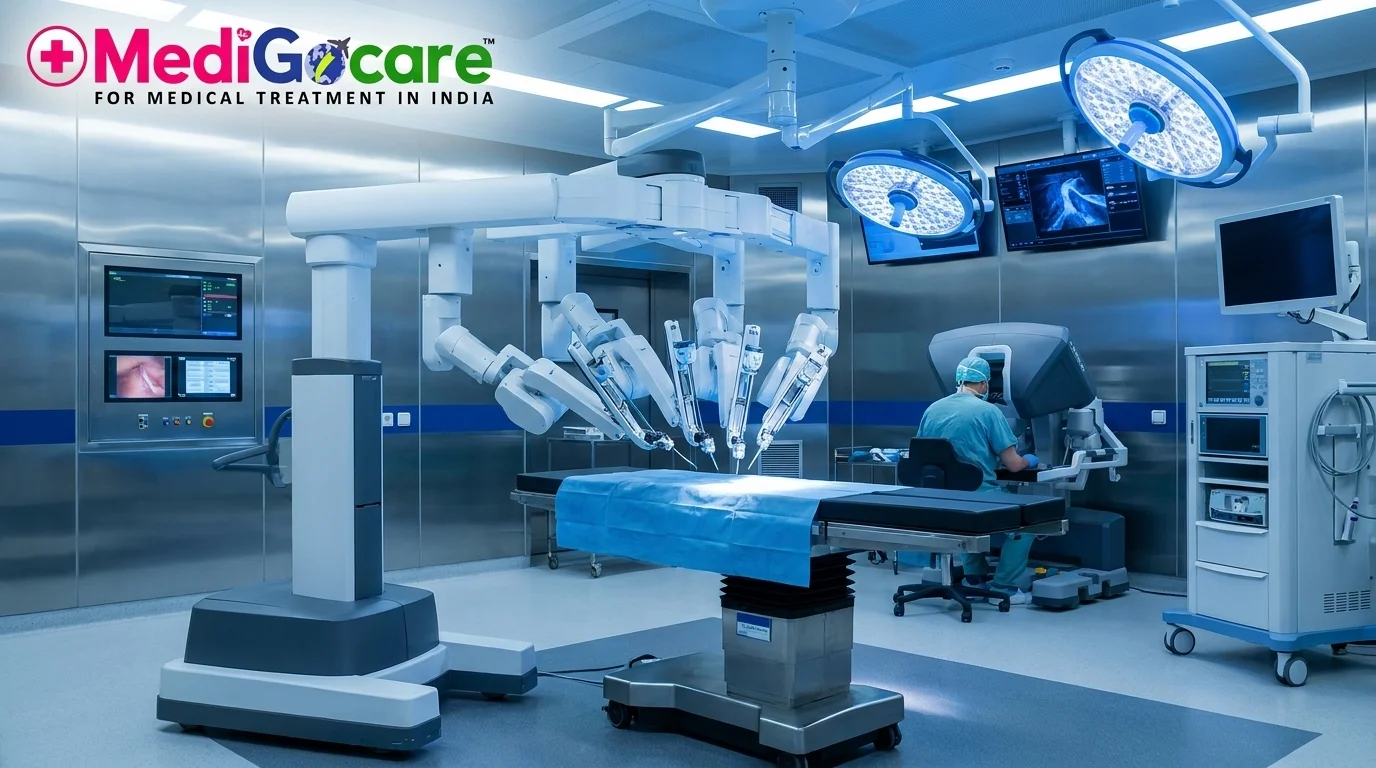
Let's be clear about something first. When we say "robotic surgery," the robot doesn't operate on its own. The Da Vinci Surgical System is entirely controlled by a human surgeon, sitting at a console just a few feet from the operating table.
What the system does is extraordinary, though. It translates the surgeon's hand movements into smaller, highly precise movements of micro-instruments inside the patient's body. The surgeon sees a magnified 3D high-definition view of the surgical field — far more detail than the naked eye or a standard laparoscope could ever provide. And crucially, the system filters out the natural tremor in a surgeon's hand, so every movement is as precise as it can physically be.
The Da Vinci system typically uses four robotic arms. Three hold the surgical instruments; one holds the 3D camera. The arms can rotate 360 degrees and bend in ways a human wrist simply cannot, which makes them ideal for working in the tight, complex spaces inside the pelvis, abdomen, and chest — exactly where many cancers occur.
This matters enormously for cancer surgery. Tumour removal requires both precision and control. Getting clean margins (removing all cancer cells while sparing healthy tissue) is what determines outcomes. The Da Vinci system was built for exactly that.
Laparoscopic surgery was itself a revolution when it arrived. But robotic surgery takes minimally invasive surgery several steps further. Here's a direct comparison across the six parameters that matter most:
| Parameter | Robotic Surgery | Laparoscopic Surgery | Open Surgery |
|---|---|---|---|
| Vision | 3D HD magnified (10x) | 2D flat screen | Direct naked eye |
| Instrument range of motion | 360°, wristed | Limited, rigid | Full human hand |
| Tremor control | Yes — filtered | No | No |
| Blood loss | Minimal (5–10x less vs open) | Low–moderate | Higher |
| Hospital stay | 2–5 days | 3–6 days | 7–14 days |
| Recovery time | 2–4 weeks | 3–6 weeks | 6–12 weeks |
The table above isn't just numbers. For a patient flying home to the UK or Nigeria after surgery, the difference between a 3-day stay and a 10-day stay is enormous — in cost, in comfort, and in how quickly life gets back to normal.
Robotic surgery isn't a one-size approach. It's suited to specific cancers where precision and the ability to work in confined spaces makes a real clinical difference. Here's where it works best.
Robotic radical prostatectomy is the most commonly performed robotic cancer procedure worldwide — and India is no exception. For localised prostate cancer, the 5-year survival rate after robotic prostatectomy is over 99%, according to peer-reviewed data. The key advantage beyond survival, however, is quality of life. Nerve-sparing robotic prostatectomy significantly improves the chances of preserving continence and sexual function compared to open surgery. Most patients at top Indian centres are catheter-free within 5–7 days and continent within 6–8 weeks. Explore our Prostate Cancer Treatment India page for full programme details.
For kidney tumours, the goal is to remove the cancer while preserving as much healthy kidney tissue as possible — what surgeons call "nephron-sparing." Robotic partial nephrectomy achieves this better than open surgery. Success rates for localised kidney cancer approach 95%+ at experienced Indian centres. Hospital stay typically runs 2–3 days vs 5–7 days for open surgery. Furthermore, the risk of needing dialysis later in life is reduced when more kidney tissue is saved. See our dedicated Kidney Cancer Treatment India page.
Robotic lower anterior resection (for rectal cancer) and right hemicolectomy (for right-sided colon cancer) are two procedures where robotic surgery's precision clearly benefits patients. The pelvis is a confined space, and operating in it robotically means less blood loss, reduced damage to the nerves controlling bladder and sexual function, and faster return of bowel function. Most patients resume oral fluids within 24 hours and are eating normally within 2–3 days. Learn more at Colon Cancer Treatment India.
Robotic radical hysterectomy is now the standard of care for early-stage cervical and endometrial (uterine) cancers at top Indian centres. It's particularly suited to stages 1 and 2 cervical cancer and endometrial cancer, where lymph node dissection alongside tumour removal demands extreme precision. Recovery is considerably faster — most patients are walking within 24 hours and are discharged in 2–3 days. For full details, visit our Cervical Cancer Treatment India page.
Robotic gastrectomy — partial or total stomach removal for gastric cancer — is available at leading Indian oncology centres. It's particularly suited to early and locally advanced gastric cancers where the precision of robotic instruments reduces surgical trauma in the upper abdomen. Blood loss is substantially lower compared to open gastrectomy, and patients tend to start oral feeding faster. Given that gastric cancer often affects older patients, the shorter recovery is especially valuable.
Robotic radical cystectomy — removal of the bladder for invasive bladder cancer — is one of the most complex abdominal cancer operations performed. Done robotically, it results in significantly less blood loss than the open approach, and lower rates of wound complications. It's available at Apollo, Medanta, and Max hospitals. This is an advanced procedure requiring a surgeon with significant robotic volume, so choosing an experienced centre matters here more than almost anywhere else.
Robotic lobectomy — removal of a cancerous lung lobe — offers real advantages over both VATS (video-assisted) and open thoracic surgery. The 3D visualisation and articulated instruments make working around the delicate structures of the chest (pulmonary vessels, bronchi, lymph nodes) considerably safer. Most patients experience less post-operative chest pain and leave hospital in 2–4 days. For complex tumours near the heart or major vessels, robotic thoracic surgery is increasingly the preferred approach at India's top centres.

This is the comparison most patients search for before making a decision — and it's where the real picture becomes clear. Robotic surgery isn't just "better for some cancers." For the right patient and the right tumour, it's a fundamentally different level of care.
| Parameter | Robotic | Laparoscopic | Open Surgery |
|---|---|---|---|
| Blood loss | Very low (5–10x less vs open) | Low–moderate | Higher |
| Hospital stay | 2–5 days | 3–6 days | 7–14 days |
| Scar size | 5–7 tiny incisions (0.5–1cm) | 3–5 small incisions | One large 15–25cm incision |
| Recovery time | 2–4 weeks | 3–6 weeks | 6–12 weeks |
| Infection risk | Very low | Low | Moderate–high |
| Surgical precision | Highest (3D, tremor-filtered) | Moderate (2D) | Dependent on surgeon ergonomics |
Source data drawn from published outcomes at Indian tertiary cancer centres and peer-reviewed literature via PubMed and National Cancer Institute.

Here's what nobody tells you upfront: the cost difference between India and the West isn't marginal. It's life-changing for families spending their savings on treatment.
| Cancer Type | India Cost (₹) | India Cost (USD) | USA Cost (USD) | Typical Savings |
|---|---|---|---|---|
| Prostate (Radical Prostatectomy) | ₹3.5L – ₹7L | $4,200 – $8,500 | $25,000 – $50,000 | ~80–85% |
| Kidney (Partial Nephrectomy) | ₹4L – ₹8L | $4,800 – $9,500 | $30,000 – $55,000 | ~82–85% |
| Colorectal (Hemicolectomy / LAR) | ₹3.5L – ₹7.5L | $4,200 – $9,000 | $28,000 – $55,000 | ~80–85% |
| Gynaecological (Radical Hysterectomy) | ₹3L – ₹6.5L | $3,500 – $7,800 | $25,000 – $45,000 | ~82–86% |
| Gastric (Gastrectomy) | ₹5L – ₹9L | $6,000 – $11,000 | $35,000 – $60,000 | ~80–83% |
| Bladder (Radical Cystectomy) | ₹6L – ₹10L | $7,200 – $12,000 | $40,000 – $70,000 | ~80–85% |
| Lung (Robotic Lobectomy) | ₹7.5L – ₹12.5L | $9,000 – $15,000 | $50,000 – $80,000+ | ~78–82% |
Costs are estimates for 2026 and include surgeon fee, hospital stay (standard room), anaesthesia, and standard nursing care. They exclude pre-operative diagnostics, post-operative hotel stay, and international travel. Contact MediGoCare for a personalised cost estimate based on your case.

Yes — but only in relative terms. Robotic surgery in India costs roughly 30–50% more than open surgery at the same hospital. So if open prostatectomy costs $5,000 at Apollo Delhi, the robotic version may run $7,000–$8,000.
However, the total cost of treatment often works out similar — because robotic surgery means shorter hospital stays, lower complication rates, and faster recovery. You spend fewer nights in the hospital. You need less post-operative medication. And you get back to work faster, which matters if you're self-employed or supporting a family. The 30–50% premium in India still puts robotic surgery at 70–85% below what open surgery costs in the USA. That's the number that actually matters.
Ask Our Specialists If Robotic Surgery Is Right for Your Cancer — Free ConsultationWe understand that cost is important. But what patients ultimately need to know is: does this actually work?
The evidence is consistent and compelling. Here's a summary of disease-specific outcomes data from peer-reviewed research and Indian hospital published results:
So while no surgical procedure comes with a guarantee, the clinical data from India's leading centres — supported by NCI guidelines and European Association of Urology recommendations — is reassuring for any patient considering robotic surgery here.
India now has over 200 operational Da Vinci robotic systems — more than most countries in Europe. These aren't evenly distributed. The best outcomes come from centres with high surgical volumes. Here are the institutions MediGoCare works with most closely:
| Hospital | City | Da Vinci Units | Cancer Specialties | Accreditation |
|---|---|---|---|---|
| Apollo Hospitals | Delhi, Chennai, Hyderabad | Multiple (4+) | Prostate, Kidney, Gynaecological, Colorectal | JCI + NABH |
| Medanta — The Medicity | Gurugram | 3+ | Prostate, Kidney, Bladder, Gynaecological | JCI + NABH |
| Max Super Speciality Hospital | Delhi, Saket | 2+ | Prostate, Colorectal, Gynaecological, Lung | NABH |
| Fortis Memorial Research Institute | Gurugram | 2+ | Urology, Gynaecology, General Oncology | JCI + NABH |
| Manipal Hospitals | Bangalore, Delhi | Multiple | Prostate, Kidney, Colorectal | NABH (multiple) |
| HCG Cancer Centre | Bangalore, Ahmedabad | 2+ | Urology, Gynaecological, Colorectal | NABH |
| Kokilaben Dhirubhai Ambani Hospital | Mumbai | 2+ | Multi-specialty oncology | JCI + NABH |
All hospitals listed are MediGoCare partner institutions. We've visited each facility, assessed their robotic surgery programmes, and work directly with their international patient teams. For blood cancers, these same institutions also offer Bone Marrow Transplant in India for patients who need it.
For a broader overview of cancer treatment options at these facilities, read our Complete Cancer Treatment India Guide for International Patients.

This is the question almost every patient asks us first. And it's a fair one.
The Da Vinci Surgical System is FDA-approved (United States) and CE-marked (European Union). The Intuitive Surgical Da Vinci platform has more than 30 years of clinical history. It is not experimental technology. It's the global standard for minimally invasive cancer surgery.
In India specifically:
As with any surgery, outcomes improve with volume. We always recommend patients ask their surgeon about their personal robotic case volume — not just the hospital's total numbers. A surgeon who has performed 500+ robotic prostatectomies is a fundamentally different experience from one who has done 50.
At MediGoCare, we match patients with high-volume robotic surgeons. That's a non-negotiable standard for us.
We've walked hundreds of international patients through this process. Here's exactly what happens:
Step 1 — Free online consultation (before you travel)
You share your medical reports, imaging (CT, MRI, PET scan), and pathology reports with our team. Our oncology coordinators review these with a specialist and give you a suitability assessment for robotic surgery — usually within 48 hours.
Step 2 — Cost estimate and hospital recommendation
Based on your case, we recommend the right hospital and surgeon, and provide a transparent cost estimate. No hidden charges. We cover surgeon fees, hospital stay, anaesthesia, nursing, and standard consumables.
Step 3 — Visa and travel coordination
We assist with your medical visa application, airport pickup, and hospital-adjacent accommodation for your accompanying family. Most patients travel to Delhi, Gurugram, Mumbai, or Bangalore.
Step 4 — Surgery (2–4 hours)
Most robotic cancer surgeries take 2–4 hours. You'll be in the hospital for 2–5 days depending on the procedure. Our team stays in contact throughout.
Step 5 — Recovery hotel (1–2 weeks)
After discharge, we arrange comfortable recovery accommodation near the hospital. Our team does daily check-ins and coordinates follow-up appointments.
Step 6 — Fit-to-Fly Certificate and departure
Your treating surgeon issues a Fit-to-Fly certificate before you leave. For most robotic procedures, patients are cleared for short-haul flights in 2 weeks and long-haul (8+ hours) in 3 weeks.
Step 7 — Remote follow-up
We coordinate your post-operative follow-up consultations via telemedicine — usually at 2 weeks, 6 weeks, and 3 months post-surgery.
Robotic surgery is available for prostate, kidney, colorectal, gynaecological (cervical and uterine), gastric, bladder, and thoracic (lung) cancers at India's top hospitals. Not every cancer is suited to a robotic approach — suitability depends on tumour size, location, cancer stage, and the patient's overall fitness for surgery. MediGoCare's oncology team provides a free assessment of your robotic surgery suitability before you travel.
Most patients can fly home within 2–3 weeks of robotic cancer surgery. The minimally invasive nature of robotic surgery means recovery is significantly faster than after open surgery. For long-haul flights over 8 hours, your surgeon will typically recommend waiting 3 weeks. MediGoCare arranges a Fit-to-Fly certificate from your treating surgeon before you depart.
Yes. The Da Vinci Surgical System is FDA-approved in the USA and CE-marked across Europe. It has over 30 years of clinical data behind it. Crucially, the robot does not operate autonomously — every movement is controlled by the surgeon at the console. India has over 200 Da Vinci systems operational at accredited hospitals, with experienced surgeons performing thousands of robotic cancer procedures annually. The Intuitive Surgical website carries full FDA approval documentation.
Robotic surgery costs 30–50% more than open surgery at the same Indian hospital. However, even with that premium, robotic cancer surgery in India ($3,500–$14,500) is 70–85% cheaper than open cancer surgery in the USA ($20,000–$80,000+). The premium is often offset by shorter hospital stays, fewer complications, and a faster return to normal life. So the total out-of-pocket cost is often not as different as the sticker price suggests.
Most robotic cancer surgeries run 2–4 hours depending on the procedure. Robotic radical prostatectomy typically takes 2–3 hours. Partial nephrectomy (kidney) takes 2–3 hours. Robotic radical hysterectomy runs 2–4 hours. Robotic colorectal surgery usually takes 3–4 hours. Your surgeon will walk you through the expected duration during your pre-operative consultation.
Robotic cancer surgery typically delivers 5–10 times less blood loss, 60% shorter hospital stays (2–5 days vs 7–14 days for open), significantly smaller scars, lower infection risk, and a much faster return to normal activity (2–4 weeks vs 6–12 weeks). Cancer control outcomes are equivalent or better for most tumour types when performed by experienced robotic surgeons.
Apollo Hospitals, Medanta – The Medicity, Max Super Speciality Hospital, and Fortis Memorial Research Institute consistently rank among the best for robotic prostate cancer surgery in India. All four operate high-volume robotic urology programmes with surgeons who have performed hundreds to thousands of robotic prostatectomies. MediGoCare works directly with these institutions and can match you with the right surgeon based on your specific case.
Yes, in most cases you will need a confirmed diagnosis (pathology report or biopsy) before surgery can be planned. However, in some situations — for example, a highly suspicious kidney mass on imaging — surgery can be scheduled with the expectation of intraoperative pathological confirmation. Share your full imaging reports and available pathology with our team and we'll advise you on what's needed before travel.
Absolutely. In fact, we strongly recommend it. MediGoCare facilitates free remote second opinions from specialists at our partner hospitals. Simply upload your reports through our website and we'll connect you with an appropriate oncologist — urologist, gynaecological oncologist, colorectal surgeon, or thoracic surgeon — within 48 hours.
Our standard package covers surgeon fees, hospital accommodation (standard private room), anaesthesia, nursing care, standard surgical consumables, and post-operative inpatient care. It does not include pre-operative diagnostics (PET scan, MRI, blood tests), international flights, recovery hotel accommodation, or visa fees. We provide itemised cost estimates upfront so you can plan with confidence. There are no surprise charges.
Yes. Age alone is not a contraindication for robotic surgery. In fact, robotic surgery is often preferred for older patients precisely because of the reduced blood loss, lower infection risk, and faster recovery. Published data from Medanta and Indian urology institutions confirms that patients over 70 can safely undergo robotic radical prostatectomy with good outcomes. Suitability is assessed based on overall fitness and cardiac status, not age.
Start by calling us on +91 90858 83067 or emailing info@medigocare.com. Alternatively, fill in the consultation form on our website. Attach your most recent imaging reports and pathology results. Our oncology coordination team will review your case and respond within 24–48 hours with a suitability assessment, hospital recommendation, and cost estimate. There is no charge for this initial assessment.
24/7 Assistance with the best medical care at your service
Quality treatment with professional & unmatched personal care
Our experts make your Communication easier and more transparent

