24/7 Customer Assistance
24/7 Assistance with the best medical care at your service

Call us for any question
+91 90858 83067BLOCK-B, PH-1, Sushant Lok Phase I, Gurugram, Haryana 122001
IndiaOffice Hour: 09:00am - 09:00pm
info@medigocare.com
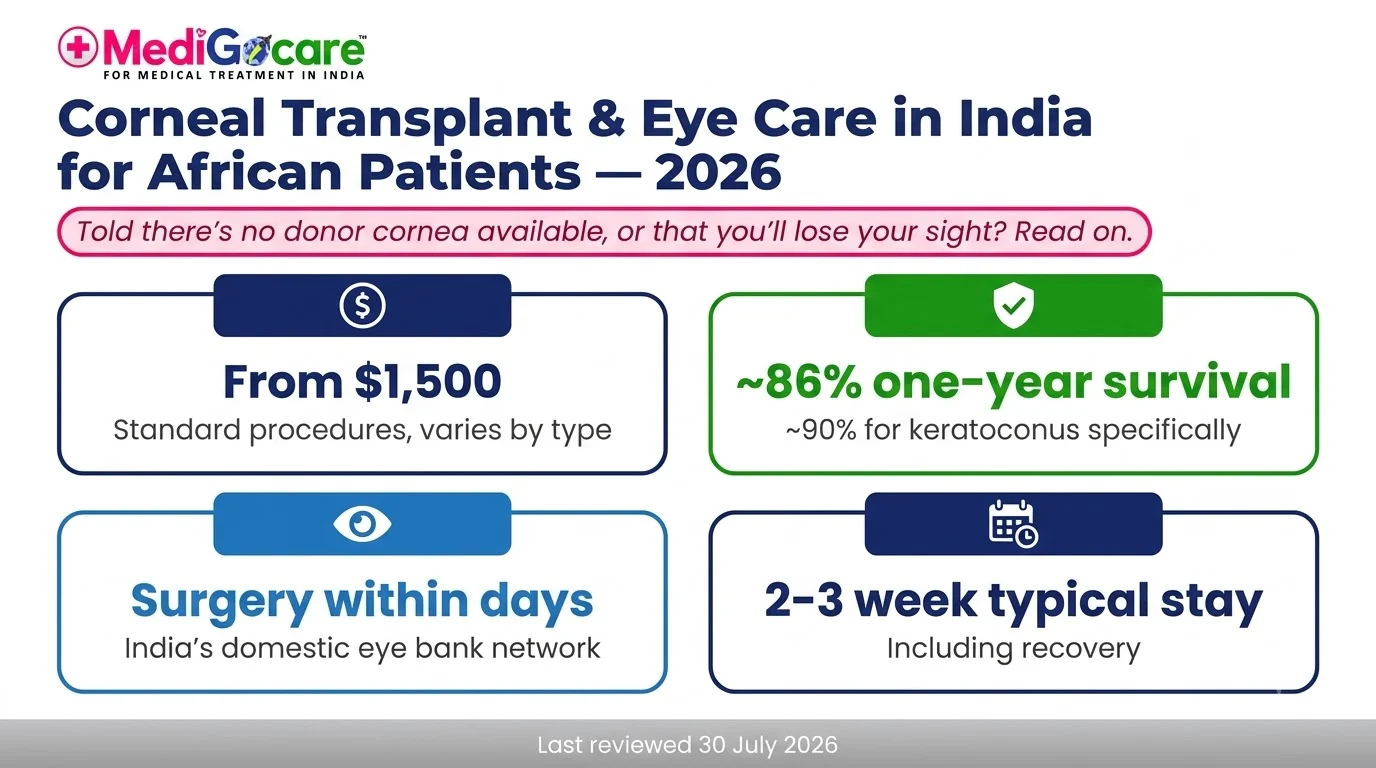
Have you been told there's no donor cornea available where you live, or that you'll lose the sight in that eye? This page is for you specifically.
Quick answer: Corneal transplant in India runs roughly $1,500-5,000 for standard procedures, with published one-year graft survival around 86% overall and close to 90% for keratoconus specifically. India's domestic eye bank network means donor tissue is typically available within days, rather than the long, import-dependent waits common across much of Africa.
Last reviewed: 25 August 2026.
If you've already been told no at home — no donor available, an open-ended waiting list, or a price for imported tissue you simply can't meet — you're not alone, and there is a real path forward. This guide walks through it honestly, including the parts that aren't perfect.
You've been told a corneal transplant is needed, but no donor tissue is available. You've been placed on a waiting list with no clear date. You've been quoted a price for imported donor tissue you can't afford. You have keratoconus and your vision keeps worsening despite glasses or contact lenses. You have corneal scarring from an old infection, injury, or previous surgery. A previous graft has failed and you've been told nothing more can be done. Or you've simply been told you'll permanently lose sight in one or both eyes. This page also covers cataract complications, retinal detachment, diabetic eye disease and glaucoma, though corneal disease is where we're starting — and where the strongest reason to travel actually lies.
Here's the argument that actually matters, more than price: donor tissue availability. Most African countries have no functioning eye bank at all. Where eye banks do exist — Ethiopia and Kenya each run one, the two with the most reach on the continent — demand still commonly outpaces domestic supply, and private-sector care leans on imported corneas, largely from the US, at a cost most patients simply can't meet. Globally, corneal disease affects an estimated 4.5 million people, and access to transplantable tissue is nowhere near even.
To put that in perspective: the World Health Organization's most recent figures put vision impairment at 2.2 billion people worldwide, with roughly 1 billion of those cases either preventable or still unaddressed — and one in two people globally who need cataract surgery simply don't have access to it. Corneal blindness sits inside that same picture of unmet need, concentrated hardest exactly where eye banking infrastructure is thinnest.
India runs its own domestic eye bank network. That means surgery can often happen within days of arrival, not months on a list with no end date. Beyond tissue supply, India also offers access to more advanced techniques — DMEK and DSEK, not only full-thickness PK — and keratoprosthesis where donor tissue genuinely isn't an option. And ophthalmic conditions sit on India's list of visa-priority conditions, which is a real, practical advantage when you apply.
We'll be honest about the flip side too: a corneal graft needs long-term follow-up, and that's genuinely harder to manage from another continent. We're naming that here, and we've built the back half of this page specifically to solve it.
Keratoconus usually starts correctable with lenses. Left alone, cross-linking may still halt its progression — but wait too long, and a transplant becomes the only option. Corneal scarring can also worsen over time, and longstanding disease can complicate surgery and lower the odds of a good outcome. Longer visual deprivation can affect how fully your vision recovers even after a technically successful graft. We won't run a countdown timer at you — but delay here has a real clinical cost, not just an emotional one.
Most patients from our research plan for a two-to-three-week trip, though this varies by procedure and healing.

The internet quotes "corneal transplant" costs anywhere from $600 to $50,000, and that spread has a clean explanation almost nobody states plainly: it depends entirely on which procedure you actually need.
| Procedure | India (indicative) | USA benchmark |
|---|---|---|
| PK — full-thickness | $3,000-15,000 | $10,000-30,000 |
| DSEK — partial, endothelial | $3,500-18,000 | $12,000-35,000 |
| DMEK — advanced endothelial, faster recovery | $2,500-14,000 | $9,000-28,000 |
| Keratoprosthesis — artificial cornea | $10,000-50,000 | $30,000-75,000 |
We publish outcomes data, including the parts that aren't flattering — real graft survival figures and a documented follow-up problem, not just the good news. We're building a follow-up plan designed to survive your flight home, which is the single most common failure point in published African corneal transplant outcomes and something no competitor addresses properly. Pricing is segmented by procedure type rather than a single confusing number that conflates a $600 quote with a $50,000 one, as several competitor sites currently do without explaining why. And like the rest of this programme, every statistic here is linked to where it came from, rather than stated as if it were simply common knowledge.


A donor cornea can't be manufactured — it comes from a person who has chosen to donate, processed through a certified eye bank under regulated screening and quality standards, and matched to a recipient within a narrow window after donation. That's genuinely why supply is scarce almost everywhere, and especially where eye banking infrastructure is thin. If you're receiving human donor tissue, you have every right to ask where it came from and how it's traced — that's not a difficult question to answer honestly, and it shouldn't be treated as one.

PK replaces the entire thickness of the cornea and is the most established option. DSEK and DMEK replace only the innermost layer — generally faster recovery, lower rejection risk, with DMEK being the newer and more technically demanding of the two. Keratoprosthesis, an artificial cornea, exists specifically for when donor tissue isn't available or previous grafts have failed repeatedly — it costs more, but it doesn't depend on donor supply at all. Which one is right depends entirely on your specific diagnosis, and that's a conversation for your written opinion, not a page like this one.

Keratoconus is the single most common reason for corneal transplant in the African patients studied in published research — two out of every three cases. It's worth saying plainly, even though it's the cheaper option: corneal cross-linking, done early enough, can halt keratoconus progression and sometimes avoid the need for a transplant altogether. We'd rather tell you that than sell you a bigger procedure.

Here's an uncomfortable, honestly reported fact from the same published Kenyan research: a third of patients who received a corneal graft never made it back for their one-year follow-up, despite every one of them verbally committing to. Graft rejection is treatable if it's caught early. It's sight-threatening if it isn't. Follow-up isn't optional — it's the difference between the outcomes above holding for you personally or not.
A closer look at that same patient group found something reassuring and something practical. The reassuring part: most of the patients who didn't come back weren't unhappy with their surgery — when researchers reached them by phone, they generally reported being satisfied. They simply didn't return, for reasons that had nothing to do with the graft itself. The practical part: patients over 60, and those with certain pre-existing conditions, were meaningfully more likely to fall out of contact — which tells us exactly who needs the most proactive follow-up support, rather than leaving it to chance.
Watch for redness, sensitivity to light, a drop in vision, or pain — any of these after you're home should mean an urgent call, not a wait-and-see. We arrange a handover to a named ophthalmologist in your home city before you leave India, not after, alongside telemedicine and photo-based check-ins. We also help you plan for medication continuity in Nairobi, Lagos, Accra or Addis, since topical steroids often continue well past your trip. Interestingly, the same research that found the follow-up problem also found that bundled follow-up packages and simple messaging reminders meaningfully help — which is exactly what we've built this plan around.

We're building a downloadable Corneal Transplant Aftercare Guide — rejection warning signs with visuals, your medication schedule, a follow-up calendar, emergency contacts, and your home ophthalmologist's details. Given the documented link between clear understanding and graft survival, this isn't a lead magnet dressed up as care. It's meant to be genuinely used.
Keratoconus (the leading cause in the African research we cite) · corneal scarring from infection or injury · corneal degeneration and dystrophies · failed previous graft · corneal opacity · bullous keratopathy · cataract with corneal involvement · retinal detachment · diabetic retinopathy · glaucoma · paediatric corneal disease.
Patients from Ethiopia, Cameroon, Kenya, Tanzania and Zambia are named directly in the research behind this page, alongside Nigeria, Uganda and Ghana.
Waiting for keratoconus to "settle" instead of asking about cross-linking while it's still an option. Comparing a PK quote against a DMEK quote as if they're the same operation — they aren't. Budgeting for surgery but not for 12 months of medication afterward. Not arranging home follow-up before you travel. Ignoring early rejection signs. Assuming a graft is permanent and maintenance-free.
Which procedure specifically, and why that one for me? Is the donor tissue fee included in the quote? Where does the tissue come from, and how is it traced? What's this surgeon's actual graft survival rate? Who checks my eye once I'm home? And what happens if the graft fails?
Every statistic here is linked to its source: published graft-survival research, eye-banking literature, and WHO's own vision-impairment data, rather than asserted the way most pages in this space do it.
MediGoCare · BLOCK-B, PH-1, Sushant Lok Phase I, Gurugram, Haryana 122001 · +91 90858 83067 · info@medigocare.com
Send your eye reports for a written opinion — including whether a transplant is actually needed at all.
Send Your Eye Reports for a Written Opinion Message Us on WhatsApp24/7 Assistance with the best medical care at your service
Quality treatment with professional & unmatched personal care
Our experts make your Communication easier and more transparent