24/7 Customer Assistance
24/7 Assistance with the best medical care at your service

Call us for any question
+91 90858 83067BLOCK-B, PH-1, Sushant Lok Phase I, Gurugram, Haryana 122001
IndiaOffice Hour: 09:00am - 09:00pm
info@medigocare.com
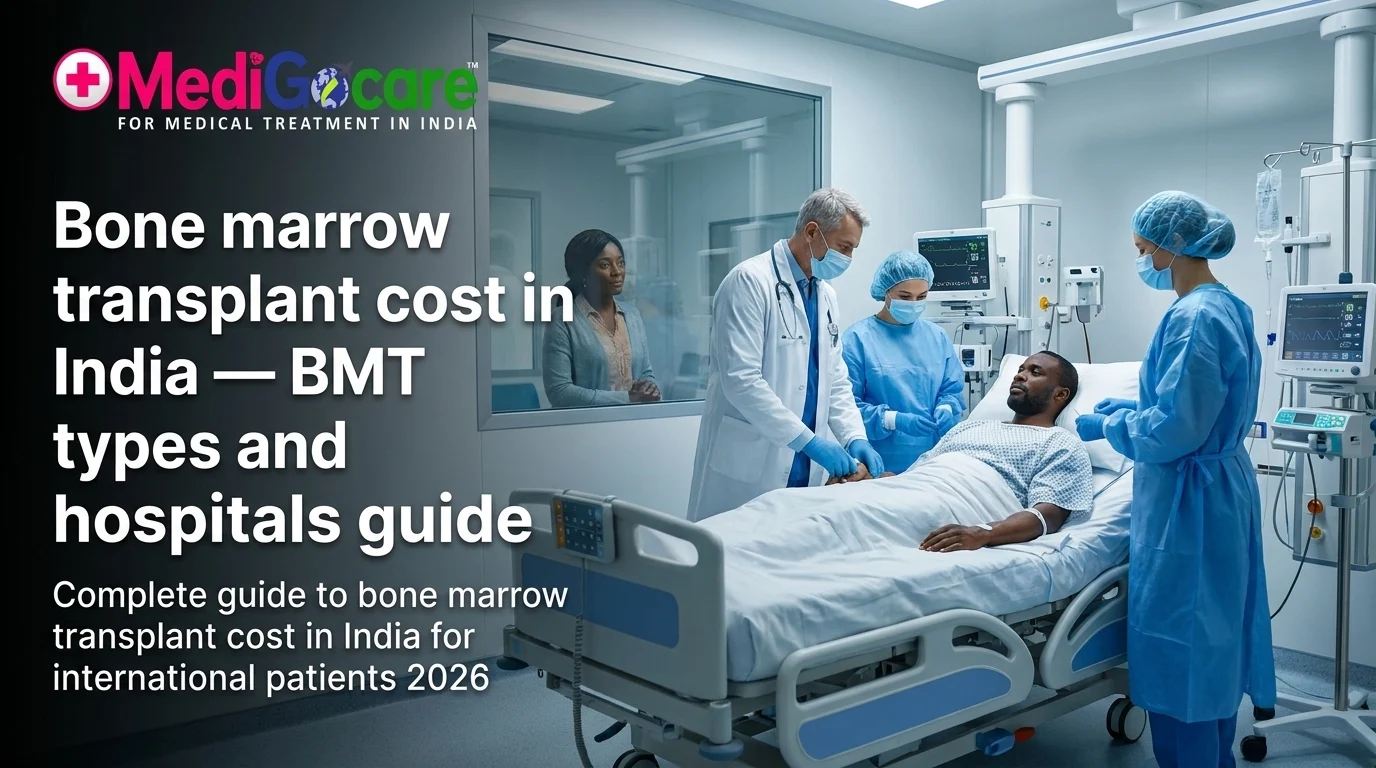 Complete guide to bone marrow transplant cost in India for international patients 2026
Compare autologous, allogeneic, and haploidentical BMT costs at India's top hospitals.
In our experience working with hundreds of families from Nigeria, Bangladesh, Nepal, the UAE, and East Africa, we've found that one question comes up almost every time — "Can we really afford a bone marrow transplant?"
The answer, honestly, surprises most people. India has quietly become one of the world's most advanced destinations for BMT, and the costs are a fraction of what families pay in the US or UK. We've seen patients who were quoted $400,000 in the United States complete the same procedure in India for under $25,000 — with outcomes that match global standards.
This guide covers everything you need to know. Whether your child has thalassemia or a family member is fighting leukemia, you'll find real numbers, honest comparisons, and the exact steps to get started. Also, we link to our full Cancer Treatment India Guide for International Patients if you need a broader picture first.
A bone marrow transplant — also called a stem cell transplant or HSCT (haematopoietic stem cell transplantation) — replaces damaged or diseased bone marrow with healthy stem cells. The National Cancer Institute describes it as one of the most powerful treatments available for blood cancers and certain genetic disorders.
Bone marrow is the spongy tissue inside your bones. It makes your red blood cells, white blood cells, and platelets. When it fails — because of cancer, a genetic condition, or chemotherapy damage — the body can't produce healthy blood. BMT fixes that at the root. It's not just a treatment. For many conditions like thalassemia and aplastic anemia, it's an actual cure.
Doctors typically recommend BMT when standard chemotherapy or other treatments aren't enough. Also, for bone marrow cancer treatment in India, it remains the gold-standard approach.
India's top BMT centres treat a wide range of blood and immune system disorders. Here's a breakdown of what we most commonly help international patients with.
Leukemia is the most common reason patients come to India for BMT. Whether it's Acute Myeloid Leukemia (AML) or Chronic Myeloid Leukemia (CML), an allogeneic transplant from a matched donor can put the disease in long-term remission. We work with India's leading haematologists for Blood Cancer Treatment in India — and outcomes here are genuinely competitive with top Western centres.
Lymphomas that relapse after chemotherapy often respond well to an autologous BMT, where the patient's own stem cells are used. For patients who've already tried multiple lines of therapy, this is frequently the next step. We help coordinate Non-Hodgkin Lymphoma Treatment in India at hospitals with dedicated haematology units and high-volume transplant programmes.
Autologous BMT is the primary treatment for multiple myeloma, especially after initial induction chemotherapy. India's hospitals perform this procedure routinely, with good recovery outcomes even in older patients.
Aplastic anemia is a condition where the bone marrow simply stops producing enough blood cells. An allogeneic BMT from a matched sibling is curative in most cases. In our experience, families from Bangladesh and East Africa particularly seek India for this — because the cost difference versus home-country or Western options is enormous.
This one is close to our hearts. Thalassemia is common across South Asia, the Middle East, and Africa. Children under 14 who undergo BMT for thalassemia in India achieve an 85–90% cure rate at leading centres. That's not a management plan — that's a permanent cure. India has some of the highest BMT volumes for paediatric thalassemia globally, with specialists who handle dozens of such cases every year. Leukemia Treatment India specialists often collaborate on complex paediatric cases too.
BMT is currently the only curative treatment for sickle cell disease. India's centres have pioneered haploidentical protocols for sickle cell patients who lack a matched sibling donor, making the procedure accessible to far more patients than before.
Understanding the type of transplant your doctor recommends matters — because the cost, timeline, and donor requirements are all different.
 Autologous vs allogeneic vs haploidentical bone marrow transplant comparison India 2026
| BMT Type | Donor | Who Needs It | Cost (India) | Timeline | Best For |
|---|---|---|---|---|---|
| Autologous | Patient's own cells | Myeloma, lymphoma | ₹10L–₹25L (~$12K–$30K) | 3–4 weeks hospital | Multiple myeloma, relapsed lymphoma |
| Allogeneic | Matched sibling/registry | Leukemia, aplastic anemia | ₹20L–₹45L (~$24K–$54K) | 4–6 weeks hospital | Leukemia, aplastic anemia, thalassemia |
| Haploidentical | Half-matched parent/child | No matched sibling available | ₹25L–₹55L (~$30K–$66K) | 4–6 weeks hospital | Most blood cancers, no matched donor |
| Cord Blood | Banked umbilical cord | Paediatric patients | Varies | Slower engraftment | Children, rare diseases |
No donor is needed. Your stem cells are harvested before high-dose chemotherapy, stored, and then reinfused. This is the most affordable type, costing ₹10 lakh to ₹25 lakh in India. It works best for multiple myeloma and certain lymphomas where the cancer hasn't affected the bone marrow.
This needs a matched donor — ideally a sibling. If no family match exists, India has access to national registry DATRI and the global network through WMDA (World Marrow Donor Association) for unrelated donor searches. Costs run ₹20 lakh to ₹45 lakh, and this is the most effective approach for leukemia, aplastic anemia, and thalassemia.
This is arguably India's biggest BMT innovation story. A parent, sibling, or child can donate — even without a full HLA match. India has pioneered the post-transplant cyclophosphamide (PTCy) protocol, which dramatically reduces the risk of graft-versus-host disease (GVHD) in haploidentical transplants. Centres like Medanta and Tata Memorial Hospital now report haploidentical outcomes approaching those of fully matched transplants. Cost: ₹25 lakh–₹55 lakh.
For patients who relapse after BMT, CAR-T Cell Therapy in India is the next frontier — and India now offers this too.
Cord blood transplants use stem cells from a banked umbilical cord. No live donor is needed, which speeds up matching. However, engraftment takes longer, and the cell dose is smaller — so this is typically used for children or smaller adults.
Let's talk real numbers. This is the section most families jump to first, and honestly, it's why India is on so many people's shortlist.
| BMT Type | India Cost (₹) | India Cost (USD) | USA Cost (USD) | UK Cost (GBP) | Savings vs USA |
|---|---|---|---|---|---|
| Autologous | ₹10L–₹25L | $12,000–$30,000 | $150,000–$300,000 | £80,000–£140,000 | ~80% savings |
| Allogeneic | ₹20L–₹45L | $24,000–$54,000 | $300,000–$600,000 | £150,000–£280,000 | ~85% savings |
| Haploidentical | ₹25L–₹55L | $30,000–$66,000 | $400,000–$800,000 | £180,000–£350,000 | ~87% savings |
| Cord Blood | ₹18L–₹35L | $21,500–$42,000 | $250,000–$500,000 | £120,000–£220,000 | ~83% savings |
 How much cheaper is bone marrow transplant in India compared to USA? 2026 comparison
For broader cost context, our Cancer Treatment Costs India — Full Comparison covers multiple procedures side by side.
When a top Indian hospital quotes you a BMT cost, here's what it generally covers:
We always ask hospitals for an itemised quote. That's one of the first things we do when we take on a case at MediGoCare.
Honesty matters here. Beyond the core hospital bill, you should plan for:
The total realistic budget for an international patient — including all of the above — typically falls between $30,000 and $90,000 depending on transplant type. Still dramatically less than any Western country.
Success rates at India's leading centres have genuinely caught up with the West. According to published outcomes data — including studies available on PubMed for haploidentical transplants at Indian institutions — this is no longer a developing-world story. These are world-class numbers.
| Disease | Transplant Type | 5-Year Survival / Cure Rate (India) | Notes |
|---|---|---|---|
| AML (first remission) | Allogeneic | 55–65% | Best outcomes with early-stage disease |
| ALL (with matched donor) | Allogeneic | 70–80% | Children respond better than adults |
| Hodgkin Lymphoma (relapsed) | Autologous | 75–85% | High success with good pre-transplant response |
| Non-Hodgkin Lymphoma | Autologous | 65–75% | Varies by histology |
| Multiple Myeloma | Autologous | 80–90% (3-yr PFS) | Maintenance therapy improves outcomes further |
| Aplastic Anemia (matched sibling) | Allogeneic | 75–85% | Near-curative with young patients |
| Thalassemia (children under 14) | Allogeneic | 85–90% cure | Among the best outcomes globally |
| Sickle Cell Disease | Haploidentical | 75–85% | India leads in haplo-SCD protocols |
 BMT success rates in India 2025 — disease-wise survival data for leukemia, thalassemia, aplastic anemia
Overall, India's top BMT centres report 70–80% overall survival across all transplant types — consistent with EBMT benchmarks for European transplant registries. The Tata Memorial Centre's Haematology Department in particular is internationally recognised for its transplant volumes and research output.
Not all hospitals are created equal when it comes to BMT. Volume matters enormously — a centre that does 200+ transplants per year will have better outcomes and a more experienced team than one doing 20. Here are the hospitals we most frequently work with:
| Hospital | City | Speciality | Annual BMT Volume | Accreditation |
|---|---|---|---|---|
| Tata Memorial Centre | Mumbai | All types, paediatric | 300+ | NABH, Government Premier |
| Medanta – The Medicity | Gurugram | Haploidentical pioneer | 250+ | JCI, NABH |
| Apollo Hospitals | Delhi, Chennai, Hyderabad | Allogeneic, paediatric | 200+ | JCI, NABH |
| Fortis Healthcare | Delhi, Bengaluru | Myeloma, lymphoma | 150+ | NABH |
| Kokilaben Dhirubhai Ambani Hospital | Mumbai | Paediatric BMT, thalassemia | 150+ | JCI, NABH |
| Max Super Speciality Hospital | Delhi | Adult and paediatric BMT | 180+ | NABH |
All six are either JCI- or NABH-accredited, which means they meet international quality and safety standards. MediGoCare has direct relationships with transplant coordinators at each of these centres, so we can give you a real turnaround time and actual cost estimate — not just a website quote.
One of the most common things we hear from families: "We just don't know what we're walking into." So let's lay it out simply.
First, we arrange HLA (human leukocyte antigen) typing for the patient and potential family donors. This blood test determines compatibility. If no family match is found, we search India's national registry DATRI and the global WMDA network. For patients without a match, haploidentical transplant is the next step — and it's widely available.
The transplant team runs a complete assessment — cardiac function, lung function, kidney and liver tests, bone marrow biopsy, imaging. This ensures the patient is fit for the conditioning regimen. We coordinate this with the hospital remotely as much as possible, so you're not spending unnecessary time in India before the main process starts.
This phase destroys the existing bone marrow to make room for the new cells. It's intense. Patients stay in hospital during this time. The conditioning regimen varies by disease — myeloablative (full intensity) or reduced-intensity conditioning (RIC) for older or less fit patients.
This is the actual transplant — though it looks anticlimactic. The stem cells are infused through an IV line, similar to a blood transfusion. It typically takes a few hours. The real work happens next.
The new stem cells travel to the bone marrow and start producing blood cells. This takes 2–4 weeks, during which the patient is in a strict isolation room. The immune system is essentially zero — so infection prevention is critical. Daily blood counts track engraftment progress.
After discharge, patients stay near the hospital for 2–3 months for close follow-up. At 100 days, 6 months, and 1 year, bone marrow biopsies and chimerism tests confirm the new marrow is working. Most international patients return home after the 100-day mark, with remote follow-up through MediGoCare.
 What to expect during bone marrow transplant in India — step-by-step patient journey with MediGoCare
We've built MediGoCare specifically for international patients. Not for Indian patients — for people flying in from Nigeria, Kenya, Bangladesh, Nepal, Afghanistan, the UAE, Oman, Sudan, and elsewhere. The process is different, and the support needed is different.
Here's how we work:
Dr Rahul Bhargava in 2016 became the first Indian doctor to do and popularize stem cell transplant in multiple sclerosis. He has been credited of establishing 6 low cost centres across India namely at Sarvodaya hospital, Batra hospital, Action Balaji hospital etc.. He and his team has done 1000+ transplants. He is known for his excellent outcome in stem cell transplant specially in haploidentical transplant and his vision of first integrated centre of excellence in Haematology, paediatric haematology and stem cell transplant has been full filled at FMRI Gurgaon.
Bone marrow transplant cost in India ranges from ₹10 lakh to ₹55 lakh ($12,000–$66,000 USD), depending on the type. Autologous BMT costs ₹10 lakh–₹25 lakh. Allogeneic is ₹20 lakh–₹45 lakh. Haploidentical runs ₹25 lakh–₹55 lakh. This is 70–80% cheaper than the same procedure in the USA, which costs $300,000–$800,000 depending on type and hospital.
Yes. India has DATRI — a national bone marrow donor registry with over 700,000 registered donors. For patients who can't find a family match, DATRI works alongside the global WMDA network to search international registries. Additionally, haploidentical transplant means any parent, sibling, or child can donate even without a full HLA match — so the vast majority of patients today can find a suitable option.
Success rates vary by disease. AML in first remission: 55–65% five-year survival. ALL with a matched donor: 70–80%. Thalassemia in children under 14: 85–90% cure rate. Aplastic anemia with a matched sibling: 75–85%. Multiple myeloma (autologous): 80–90% three-year progression-free survival. India's top centres report outcomes comparable to Western institutions, particularly for high-volume procedures like haploidentical and paediatric transplants.
The complete journey from first consultation to returning home takes roughly 4–6 months. Broken down: HLA typing and donor matching takes 2–4 weeks. Pre-transplant evaluation takes 1–2 weeks. Conditioning chemotherapy runs 1–2 weeks. Hospital isolation after transplant runs 3–5 weeks. Early recovery and monitoring takes 4–8 more weeks before it's safe to fly home.
Yes, and India is actually one of the global leaders in this technique. Centres like Medanta, Tata Memorial, Apollo, and Kokilaben perform haploidentical transplants routinely using the post-transplant cyclophosphamide protocol. A parent or child can serve as the donor — even without a full HLA match. Success rates now approach those of fully matched transplants, making BMT accessible to almost every patient who needs it.
You need an Indian e-Medical Visa. Apply online at indianvisaonline.gov.in with your hospital's official invitation letter, medical records confirming your diagnosis, and a valid passport. MediGoCare provides the official hospital invitation letter and guides you through the entire application at no extra charge. Visa approval typically takes 5–7 working days.
Graft-versus-host disease (GVHD) happens when the donor's immune cells attack the patient's body after an allogeneic transplant. It's a known risk, especially with unrelated or haploidentical donors. India's BMT units use immunosuppressive protocols — including tacrolimus, methotrexate, and in haploidentical cases, post-transplant cyclophosphamide — to prevent and manage it. Experienced centres see GVHD rates and severity that are consistent with international benchmarks.
The conditioning chemotherapy before the transplant is the hardest part — it causes fatigue, nausea, mouth sores, and hair loss. The actual stem cell infusion on Day 0 is generally well-tolerated and not painful. The recovery period involves fatigue and close monitoring. Most patients say the weeks after transplant are more emotionally challenging than physically painful — and that's where strong family support and a good care team make all the difference.
Yes. India's centres offer reduced-intensity conditioning (RIC) protocols specifically designed for older patients or those with co-morbidities who can't tolerate full myeloablative chemotherapy. For children, India has dedicated paediatric BMT units — particularly at Tata Memorial and Kokilaben — with specialists who handle thalassemia, ALL, and sickle cell disease in young patients every day.
Send your reports directly to MediGoCare. You can WhatsApp them to +91 90858 83067 or email them to info@medigocare.com. Our team reviews bone marrow biopsy reports, HLA typing results (if done), CBC, imaging, and treatment history. We respond within 24 hours with a detailed assessment and hospital recommendation. There is no charge for this evaluation.
Absolutely. We've coordinated BMT for patients from Nigeria, Kenya, Sudan, the UAE, Oman, Qatar, and several other countries. India's major BMT hospitals have dedicated international patient services, English-speaking staff, and experience with patients who carry different haemoglobin variants and genetic profiles common in African and Middle Eastern populations. Culturally appropriate food, prayer spaces, and interpreter services are available at most major centres.
Post-transplant follow-up continues for at least 1–2 years. You'll need blood tests, chimerism checks (to confirm donor cells are stable), bone marrow biopsies at scheduled intervals, and ongoing immunosuppression management. MediGoCare connects you with a local haematologist in your home country and stays in contact with your Indian BMT team for any remote consultations. You're not on your own after you fly home.
We help you navigate what your insurance policy covers. While most international insurance plans don't directly cover elective treatment abroad, medical travel insurance and some corporate health plans do offer reimbursement pathways. We provide all the documentation hospitals and insurers need. For families without insurance, several India hospitals offer structured payment plans — particularly for paediatric cases. Ask us when you reach out.
India's combination of internationally trained haematologists, JCI-accredited hospitals, 70–80% lower costs, and established infrastructure for international patients makes it genuinely the best value option for BMT globally. Moreover, India's leadership in haploidentical protocols means patients who have no matched donor — a situation that would close many doors in the US or Europe — still have excellent options here.
So whether you're coming from Dhaka, Lagos, Dubai, or Kathmandu, we've seen families walk out of Indian hospitals with outcomes that changed their lives permanently.
The question isn't whether India is good enough. It's how to get started.
WhatsApp MediGoCare at +91 90858 83067 — our oncology team responds 7 days a week.
Email: info@medigocare.com
Website: https://medigocare.com
Address: BLOCK-B, PH-1, Sushant Lok Phase I, Gurugram, Haryana 122001
24/7 Assistance with the best medical care at your service
Quality treatment with professional & unmatched personal care
Our experts make your Communication easier and more transparent

