24/7 Customer Assistance
24/7 Assistance with the best medical care at your service

Call us for any question
+91 90858 83067BLOCK-B, PH-1, Sushant Lok Phase I, Gurugram, Haryana 122001
IndiaOffice Hour: 09:00am - 09:00pm
info@medigocare.com
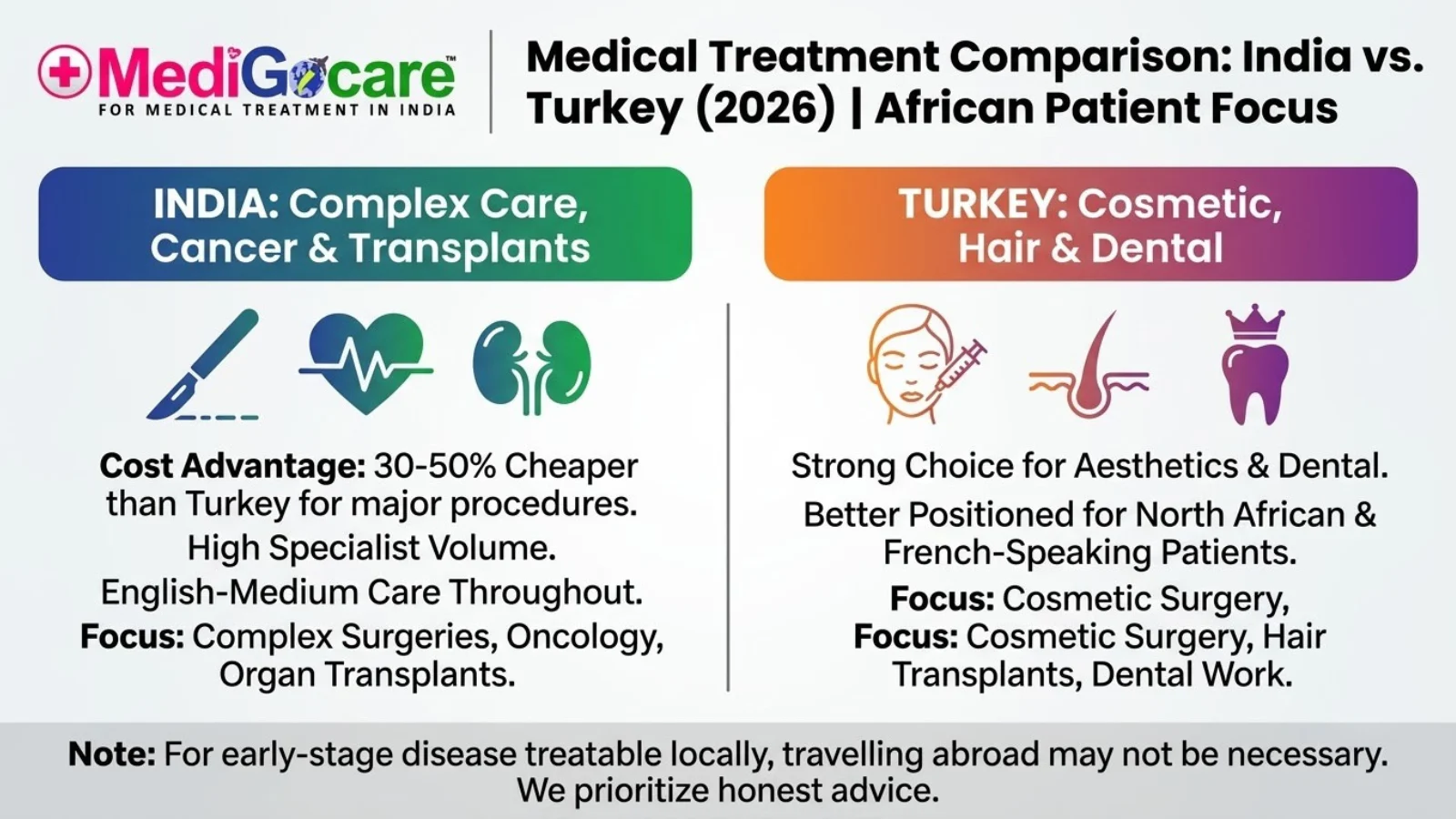
Quick answer: For complex surgery, cancer care and transplants, India typically runs 30-50% cheaper than Turkey, with greater specialist volume and English-medium care throughout. Turkey is the stronger choice for cosmetic surgery, hair transplants and dental work, and is genuinely better positioned for North African and French-speaking patients. For early-stage disease that's treatable locally, travelling abroad may not be the right call at all — and we'll say so.
Last reviewed: 20 August 2026.
This isn't a page trying to talk you into flying to India. If your situation is better served by staying home, or by going to Turkey instead, we'll tell you that directly. We'd rather lose your business than let you make a decision you'll regret.
You're probably here because one of these describes you: you have a diagnosis and you're choosing between destinations. You've had quotes from both Turkey and India and they don't line up. You're not sure travelling is necessary at all. You want the real risks, not just the savings pitch. Or — and we mean this seriously — you're wondering whether it's worth spending your family's savings on this trip.

Staying home is the right answer for a lot of patients. Early-stage disease, standard protocols your local system can already deliver, easier follow-up, family close by, no risk of financial devastation — if that's your situation, travelling abroad adds cost and disruption without adding a benefit. We're saying this first, deliberately, because most facilitator pages never say it at all — and it's exactly the option a business built on medical travel has the least incentive to mention.
Turkey genuinely leads on cosmetic surgery, hair transplant and dental work — it has the largest, most competitive ecosystem for these procedures anywhere. Istanbul sits roughly 6-7 hours from Lagos, noticeably shorter than Delhi's 9-11. Turkey is also the stronger fit if you're from North Africa or if French is your primary language, for reasons we get into below. Some patients also like combining treatment with time in Europe.
India wins on complex cardiac surgery, transplant, advanced oncology and neurosurgery, where surgical volume runs deep and outcomes benefit from it. Care happens in English throughout. India's Medical Visa category is built specifically for longer or multi-stage treatment, and the sub-Saharan African corridor is well established, with lower typical costs for serious surgery than almost anywhere else. Our own network sits inside the Delhi NCR hospital cluster specifically, which is where a large share of that surgical volume concentrates.

Here's something most comparison pages skip entirely: real published research on how African patients actually decide, not just why a marketing page thinks they should.
A case-control study of 254 Kenyan cancer patients — 174 treated at home, 80 who travelled, every single one of whom chose India — found that cost mattered to about three-quarters of respondents, but wasn't actually what separated the two groups once researchers controlled for other factors. What did separate them: physician advice was 66 times more likely among those who travelled, friends' and family's opinions were 42 times more likely, and the perception of better quality of care was 22.5 times more likely. Higher monthly income also mattered — patients earning above $250 a month were nearly 39 times more likely to have travelled.
There's a second thread in the same data worth pausing on. Patients who eventually travelled had known about their diagnosis for an average of 26 months before they left, against just 8 months for those treated in Kenya. That's unlikely to be a coincidence. For a meaningful share of patients, the decision to travel seems to come after a period of delay rather than instead of one — which is exactly why the point about the cost of delaying, further down this page, isn't just a line we're using to make a case.
The same research turned up something else worth knowing if a private hospital is the one referring you onward: private facilities referred 73.8% of the patients who eventually went to India, against just 5.6% from government facilities. That doesn't make private-sector advice wrong. It's simply a reason to get a second, independent opinion regardless of where your first referral comes from.
What does all this mean for you? If your own doctor thinks local treatment is adequate, that carries real weight — arguably more than anything a comparison table can tell you. We'd rather you trust that advice than compete with it.
Every comparison site sells the savings. Almost none names the risk sitting right next to it.
Published research tracking 2,833 overseas cancer patients treated in Delhi, Gurgaon and Kolkata — Gurgaon being where we're based — found an average financial-toxicity score of 61%, well above the 45.8% seen in wealthy countries' own in-country patients. Only 7.7% of these patients had any insurance or sponsorship at all. Separately, one study estimated Nigerians alone spend roughly $1 billion a year on international healthcare, with 60% of that going toward oncology, orthopaedics, nephrology and cardiology.
Medical travel can cause real financial harm. Families sell assets, deplete savings, or take on debt, sometimes without the outcome justifying it. We think naming that plainly, before you commit to anything, is more useful to you than pretending it doesn't happen.
So how do you actually work out whether this is affordable, rather than just hoping it'll be fine? Start with the full number, not the headline procedure cost: treatment, flights, visa, accommodation, attendants, and any follow-up trip, all added together. Then ask honestly whether paying that number means selling an asset, taking on debt, or draining savings you can't rebuild afterward. A yes to that question isn't automatically a reason to stop — but it is a reason to have a hard conversation with your family before you commit, and to ask us directly whether a lower-cost path fits your specific case.
To be direct about where we land on this: if your situation combines a highly uncertain prognosis, a cost that would consume everything your family has, and little realistic chance of recovering financially whatever the outcome, that's exactly the kind of case where we'd tell you honestly that travel may not be the right decision — not steer you toward it anyway.
Delay has a cost: conditions progress and options narrow. But rushing has costs too — travelling without a second opinion, without complete staging, without confirmed funds, or for a procedure that could genuinely have been handled at home. Neither extreme serves you. We won't run a countdown timer at you either way.


These figures need confirming against current partner-hospital pricing before publish, but they reflect the range we consistently see quoted across this vertical:
| Procedure | India | Turkey | UK (private) | USA |
|---|---|---|---|---|
| Heart bypass (CABG) | $4,500-7,000 | $10,000-15,000 | $30,000-50,000 | $100,000-150,000 |
| Knee replacement | $8,000-12,000 | $12,000-20,000 | $20,000-35,000 | $30,000-50,000 |
| Liver transplant | $28,000-35,000 | $40,000-60,000 | $100,000+ | $250,000-500,000 |
| Kidney transplant | $18,000-25,000 | $30,000-45,000 | $50,000-80,000 | $100,000-200,000 |
| Robotic prostatectomy | $6,500-9,000 | $12,000-18,000 | $25,000-40,000 | $40,000-60,000 |
| Cataract surgery (both eyes) | $1,500-2,500 | $2,000-4,000 | $3,000-6,000 | $5,000-8,000 |
| Hair transplant (FUE) | $1,500-3,500 | $1,500-4,000 | $8,000-15,000 | $10,000-25,000 |
Notice hair transplant sits close to parity — we've kept that row in deliberately. A comparison table that only ever favours one side isn't a comparison, it's an advertisement.
We cite our sources — every figure on this page links to where it came from, which is the differentiator on this particular topic, since most comparison sites assert numbers with nothing behind them. We're on the ground in Gurugram, work with named partner surgeons, and we'll tell you directly if your situation is better served at home or in Turkey. We won't claim to be "the only honest comparison" — that's an assertion anyone can make. Sourcing, unlike honesty, is something you can actually verify.

We don't have consented Ghanaian, Nigerian or Kenyan patient stories to publish yet, and we won't invent one. What we can show you is our partner hospital accreditations and named surgeon profiles, linked throughout this page.
Surgical volume in cardiac, transplant, neurosurgery and complex oncology is genuinely where India separates itself, and it's backed by real clinical logic: surgeons who perform a procedure hundreds of times a year tend to have fewer complications than those performing it dozens of times. That volume-outcome relationship is the strongest evidence-based argument for India, and it applies across bone marrow transplant, leukaemia care, and stem cell therapy too.
Cosmetic surgery and FUE hair transplant sit in a different league entirely — Turkey built the world's leading ecosystem for both, at genuinely competitive prices, with clinics operating at a scale few countries can match. Dental tourism infrastructure is similarly mature, often bundled with recovery-friendly packages near the clinic. Turkey's government has also backed real investment in immunotherapy and gene-therapy programmes, and its geography simply favours North African patients over a longer Delhi-bound flight.
Both countries maintain large networks of JCI-accredited hospitals. Rather than repeat an unsourced number for either side, check JCI's own public directory for current, verified counts — accreditation is a floor, not a differentiator on its own, and specialty depth varies hospital by hospital regardless of country.
Here's a real, concrete advantage for India: its dedicated medical visa category makes return visits for follow-up more straightforward than re-applying under a tourist e-visa. Both destinations offer telemedicine to some degree; confirm what happens if a complication develops after you're home, and get that answer in writing before you travel, regardless of which country you choose.
We're building a downloadable Destination Decision Worksheet — a total-cost calculator, questions to put to your own doctor, an affordability self-check, and red flags to watch for in any facilitator's quote. It's designed to be useful even if you end up choosing Turkey, or staying home.
Cardiac · Oncology · Transplant · Orthopaedic · Neurosurgery · Eye care — all areas where India leads on volume. Cosmetic and hair transplant — Turkey favoured, plainly. Dental — roughly equivalent between the two. Fertility — both offer strong options.

For sub-Saharan Africa — Nigeria, Kenya, Tanzania, Ghana, Uganda, Zimbabwe, Cameroon, Zambia, Ethiopia — India is genuinely our strongest recommendation, on cost, English-language care, and an established travel corridor built over years of patient flow through hubs like Addis Ababa and Nairobi.
For North Africa, we'll say this plainly: Turkey is often better positioned. Geography, flight time, and greater Arabic-language depth in Turkish international patient departments work in your favour if you're in Libya, Egypt, Algeria, Morocco or Tunisia. We think that concession is worth more to you than a page that pretends India suits everyone equally — and if you're weighing both, it's worth getting quotes from each before deciding rather than assuming the general rule applies to your specific case.

For Francophone West Africa, Turkey's international patient departments generally carry stronger French-language depth. We're confirming exactly what French and Arabic support our own coordination team can offer — check with us directly for your specific situation rather than assuming either way.
Choosing on headline price alone, without asking your own doctor first. Comparing a bundled package quote against an itemised one — they're not the same thing. Overlooking whether your visa's validity actually covers your full treatment period. Not budgeting the complete stay. Travelling for something that could genuinely have been done at home. Trusting any success-rate claim that can't be verified.
Which named consultant, at which hospital, handles what volume of my specific procedure? Is this quote itemised, and what isn't included? Which visa route, and does it actually cover my full treatment period? What happens if the plan changes after assessment? And — the one that tells you the most — would you ever tell me not to travel?
"Cheaper means lower quality" — false, it's a cost-structure difference, not a care difference. "All JCI-accredited hospitals are equivalent" — false, accreditation is a floor; volume and specialty depth still vary. "A tourist visa works for treatment" — false, and a mistake that can derail your entire trip. "Abroad is always better than home" — also false, and often it just isn't.
This page carries a named author Mr. Kuldeep Chetry and a named medical reviewer Dr. Rahul Bhargava, and we date-stamp it because visa rules and cost figures genuinely change. Every statistic here is linked to where it came from — the Kenya case-control study, the financial-toxicity research, official visa portals, and JCI's own directory — rather than asserted the way most comparison pages do it.
MediGoCare · BLOCK-B, PH-1, Sushant Lok Phase I, Gurugram, Haryana 122001 · +91 90858 83067 · info@medigocare.com
For complex surgery, cancer care and transplants, India is typically 30-50% cheaper than Turkey. For cosmetic surgery, hair transplant and dental work, the two countries sit close to par.
India generally offers greater surgical volume and depth in complex oncology, alongside an established sub-Saharan African patient corridor. Turkey has genuine strengths too, including growing immunotherapy and gene-therapy programmes backed by its government.
For many patients with early-stage, locally treatable disease, staying home is genuinely the right answer. Travel makes the most sense for complex, highly specialised, or locally unavailable procedures.
Yes to both. English is the working clinical language in India's major private hospitals, and Turkish international patient departments commonly operate in English too, alongside other languages.
Some facilitators offer interpretation on request, though Turkey's international patient departments generally carry deeper French-language depth. Confirm directly what's available for your specific situation.
India has a dedicated Medical Visa category built for treatment courses — 60 days via the e-Medical Visa, or 6-12 months through the regular route. Turkey has no separate medical-visa category; most patients travel on the standard e-visa or visa-free entry, typically valid up to 90 days.
60 days, with triple entry. This is confirmed across multiple sources and differs from some competitor sites that incorrectly state one year.
Often, yes. Shorter flight times and stronger Arabic-language depth in Turkish hospitals genuinely favour Turkey for patients in Libya, Egypt, Algeria, Morocco and Tunisia.
Turkey. It has the world's leading hair-transplant and cosmetic-surgery ecosystem by volume and pricing, and we say so plainly.
Real ones. Research on overseas cancer patients treated in India found an average financial-toxicity score of 61%, against 45.8% for in-country patients in wealthy nations — and only 7.7% of these patients had any insurance. Families can and do deplete savings or take on debt.
Ask whether they'd ever tell you not to travel. A facilitator with an answer that always points toward travel abroad isn't giving you an honest assessment.
You should receive a full discharge summary and handover plan for your home doctor, plus telemedicine access. Get that confirmed in writing before you travel, whichever country you choose.
Send your reports and we'll give you an honest assessment — including whether travelling is the right choice at all.
24/7 Assistance with the best medical care at your service
Quality treatment with professional & unmatched personal care
Our experts make your Communication easier and more transparent