24/7 Customer Assistance
24/7 Assistance with the best medical care at your service

Call us for any question
+91 90858 83067BLOCK-B, PH-1, Sushant Lok Phase I, Gurugram, Haryana 122001
IndiaOffice Hour: 09:00am - 09:00pm
info@medigocare.com
Thinking about treatment in India? You're not alone. Over 800 Ghanaian patients made this journey in 2024, according to India's own Ministry of Tourism data — and that number's been climbing every year. Most of them weren't chasing a bargain. They were chasing a diagnosis nobody at home could fully treat, a waiting list that didn't move, or a price tag that simply didn't add up.
This guide walks through what actually happens: the real costs, the real visa process, and the honest trade-offs. We'll also cover something almost no other guide mentions properly — bone marrow transplant for sickle cell disease, which matters enormously here in West Africa.
You're probably reading this because one of the following sounds familiar:
None of this is a knock on Ghanaian medicine. Ghana's private hospitals are genuinely capable — the honest limitation is depth for the most complex specialist surgery, not the skill of the clinicians. It's a capacity and equipment issue, and it's exactly why patients travel.

A few things keep coming up when we talk to patients:
Specialist depth is the big one. India performs a volume of complex cardiac, oncology, and transplant surgery that few countries can match, and that experience shows up in outcomes. There's also no long waiting period — once your reports are reviewed, your appointment gets confirmed before you even leave Accra. Care happens in English throughout, and the hospitals we work with are JCI or NABH accredited.
That said, we won't pretend this is easy. It's a long flight, weeks away from home, and time apart from family. Anyone considering this trip should go in with eyes open about that cost too, not just the financial one.
Delaying treatment isn't free, even when it feels like the safer choice. Conditions progress. Options narrow. For sickle cell disease specifically, cumulative organ damage over the years can eventually take transplant off the table as a realistic option — which is a real, clinically grounded reason not to put the decision off indefinitely. We're not going to run a countdown timer at you or push urgency you don't feel. But delay has a cost, and it's worth naming honestly.
Here's exactly what working with us looks like, start to finish:

These are genuinely different products, and mixing them up is one of the most common mistakes we see. Here's how they compare, using the current, government-published fees:
| Feature | e-Medical Visa | Regular Medical Visa (High Commission, Accra) |
|---|---|---|
| Fee | USD 80 (+2.5% card charge) | USD 80 for up to 6 months / USD 120 for 6-12 months (≈GH¢907 / GH¢1,345 all-in) |
| Payment | Online, by card | Cash only, in Ghana cedis |
| Validity | 60 days, triple entry | 6 months or 1 year |
| Processing | Roughly 3-5 working days | Several working days; in-person, usually two visits |
| Apply at | indianvisaonline.gov.in (official portal — nowhere else) | High Commission of India, Roman Ridge, Accra |
| Best for | Shorter stays, most surgical procedures | Longer treatment courses, follow-up flexibility |
Both routes now cost roughly the same, so don't pick based on price alone — pick based on how long you'll realistically need to stay.

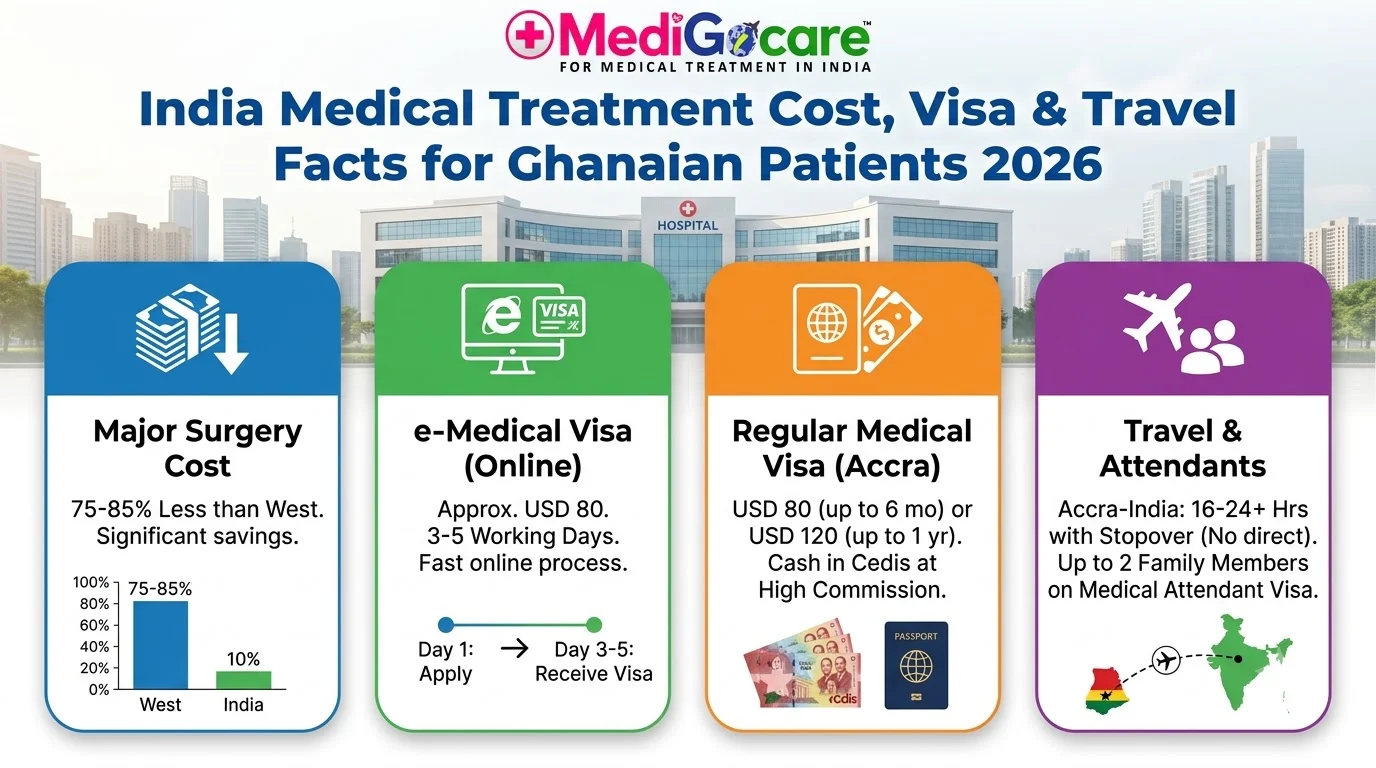
We can't publish partner-hospital pricing until it's confirmed with our hospital network, so treat any figures here as a starting range, not a quote. What we can tell you: across cardiac surgery, cancer treatment, transplant, and orthopaedic procedures, savings of 75-85% against US or UK private pricing are typical. You'll get an exact, itemised number once our medical team has reviewed your reports — free of any obligation to proceed.
A lot of guides stop at the headline procedure cost. Here's what else genuinely affects your budget:
Visa costs differ depending on the route you choose, and that cash-only, cedis-only payment rule at the High Commission catches people out more than almost anything else — bring exact change. Vaccination has its own cost and timing window; miss it, and you risk missing your trip entirely. Flight prices swing with routing and season, and Accra-to-Mumbai is sometimes noticeably cheaper than Accra-to-Delhi. Then there's accommodation across a stay that can run four weeks or more, plus flights, visas, and food for up to two attendants. And if your reports arrive incomplete, expect some repeat diagnostics on arrival — which adds both time and cost. Currency movement between your quote and your actual payment date is one more thing worth watching.
We're based on the ground in Gurugram, right in the Delhi NCR hospital cluster that most facilitators recommend from a distance. That matters more than it sounds — it means real coordination, not a call centre relaying messages.
Beyond that: we work with named partner surgeons, not an anonymous network. Our logistics information is verified and dated, which matters on a corridor where three different facilitator sites will quote you three different flight times and two different fee structures. And we won't publish a made-up "success rate" statistic — if a number can't be verified, we don't use it. That's a deliberate choice, and we think it's the right one, even if a slicker-sounding stat would be easy to write.

We'd love to show you consented stories from Ghanaian patients we've treated — Accra, Kumasi, Tamale, and beyond. Right now, we don't have any we can publish, and we're not going to invent one. What we can show you is our partner hospital accreditations and named surgeon profiles, linked throughout this page. If you're an existing patient willing to share your story, we'd genuinely love to hear from you.

This section is written for accuracy and will carry a named haematologist's review before publishing. It's the most important part of this page, and the one we've been most careful with.
Ghana sits within what's sometimes called the global sickle cell belt, and the disease burden across West Africa is significant. Here's the honest picture: bone marrow transplant can be curative for sickle cell disease in carefully selected patients. It is not a fit for everyone, and it carries real risk, including graft-versus-host disease.
A matched sibling donor gives the best odds and the most established track record. Haploidentical (half-matched, usually a parent) and unrelated donor transplants are options too, but they carry more risk and need a more careful conversation about what to expect. Eligibility depends on age, organ function, and disease severity — all things a haematologist needs to assess individually, not something a website can determine for you. If gene therapy comes up in your research, it's real, but it remains largely out of reach on cost for most patients right now.
We're not going to publish specific cost figures for this procedure until they're confirmed with our partner hospitals, and we won't use "cure your child" language anywhere on this site. If this describes your family's situation, the right next step is sending your child's reports for an individual, honest assessment — not a marketing promise.
From robotic surgery to immunotherapy and targeted treatment, Indian oncology centres offer options that often aren't yet widely available in Ghana. Our cancer treatment network covers the full range, and we've put together a detailed guide to cancer treatment in India if you want to go deeper. For blood cancers specifically, our bone marrow transplant and stem cell therapy pages cover both the process and typical costs, and our leukaemia treatment page profiles several of the named haematology specialists in our network, including Dr. Dharma Choudhary, whose focus is haematology and bone marrow transplantation.
Our cardiology network covers everything from bypass surgery to valve repair. For organ transplant — kidney, liver, or bone marrow — and for orthopaedic and brain and spine surgery, we work with named surgeons across each specialty. Notably, several of these conditions — neurosurgery, joint replacement, ophthalmic disorders, renal and cardiac conditions, organ transplant, and radiotherapy — sit on India's own list of priority conditions for medical visa approval, which can work in your favour when you apply.
Treatment doesn't end when you board your flight home. You'll leave with a complete discharge summary and a handover plan for your doctor back in Ghana, plus a clear medication and prescription plan. We'll help you figure out what genuinely needs a return visit to India and what your Ghanaian doctor can manage locally, and we offer telemedicine review so you're not navigating recovery alone. For bone marrow transplant patients specifically, long-term monitoring for infection risk and immunosuppression is part of the plan, not an afterthought.

Beyond the clinical side, here's what we help with: assistance getting your hospital invitation letter for the visa application, and a downloadable Ghana-to-India medical travel checklist covering reports, referral letters, passport requirements, photos, proof of residence, vaccination timing, and which visa route makes sense for your situation. Nobody else on this corridor has pulled all of that into one place.
We also help you figure out insurance — specifically, how to check whether your scheme covers treatment abroad, what pre-authorisation your insurer needs, and what to do if your cover is only partial.
Sickle cell disease (bone marrow transplant) · Cancer · Cardiac conditions · Kidney and liver transplant · Orthopaedic and spine · Eye care · Neurosurgery · Paediatrics · Fertility. Several of these — neurosurgery, joint replacement, ophthalmic, renal, cardiac, transplant — sit on India's visa priority list, which is genuinely useful to know when you're applying.
We work with patients from Accra, Kumasi, Tamale, Takoradi, Cape Coast, Sunyani, and Ho. If you're outside Accra, domestic connections into Kotoka International are usually straightforward to arrange around your international flight.
The single biggest one: applying for a tourist visa instead of a medical visa. It cannot be used for treatment, full stop. Others we see regularly — arriving at the High Commission without cash in cedis, missing the vaccination window, travelling without a hospital invitation letter, or sending incomplete reports that force repeat diagnostics once you've already arrived. Using an unofficial visa "agent" instead of the government portal is another one worth avoiding entirely.
Before you commit to anyone, ask: Which named consultant will actually treat me? Is the cost estimate segmented, and what does it exclude? Which visa route do you recommend, and why? Do you have staff physically at the hospital? Who holds my deposit? And what happens if the treatment plan changes after assessment?
"A tourist visa is fine for treatment" — false, and a mistake that can derail your whole trip. "Sickle cell has no cure" — not entirely true; bone marrow transplant can be curative for selected patients, though it carries real risk and isn't right for everyone. "I have to travel alone" — false, up to two attendants are permitted. "Cheaper always means lower quality" — also false. It's a difference in cost structure, not a difference in care.
This page is maintained by the MediGoCare team, and the sickle cell and bone marrow transplant section carries a named haematologist's clinical review before it goes live. We cite the Government of India's official visa portal, the Indian High Commission in Accra, India's Ministry of Tourism arrival data, and WHO travel-health guidance throughout — and we date-stamp this page because visa and vaccination rules genuinely do change.
MediGoCare · BLOCK-B, PH-1, Sushant Lok Phase I, Gurugram, Haryana 122001 · +91 90858 83067 · info@medigocare.com
Most major procedures run 75-85% less than equivalent treatment in the West. The exact number depends on your specific treatment and hospital — send your reports and we'll give you a written, itemised estimate.
The e-Medical Visa is applied for online at indianvisaonline.gov.in, currently costs USD 80 plus a 2.5% card charge, and is valid 60 days with triple entry. The regular Medical Visa is applied for in person at the High Commission in Accra, costs USD 80 (up to 6 months) or USD 120 (up to 1 year), paid in cash in cedis, and suits longer treatment courses.
As of the High Commission's fee revision effective 1 April 2026, expect around GH¢907 all-in for up to 6 months, or GH¢1,345 for 6 months to a year. Payment is cash only, in cedis, at the counter — no cards, no cheques.
Yes, without exception. Every traveller from Ghana needs a valid Yellow Fever Vaccination Certificate, ideally at least 10 days old by the time you land.
It depends on the current WHO classification. India requires proof of polio vaccination specifically from countries with active poliovirus transmission at the time of travel — check the current list before booking, since it does change.
There's no direct flight. The fastest route is via Addis Ababa on Ethiopian Airlines, at around 14 hours of actual flying time. Including a typical layover, expect a door-to-door journey of 16 to 24 hours, sometimes longer depending on your connection.
Up to two, under the Medical Attendant Visa (MED-X), which carries the same validity as your own Medical Visa.
For carefully selected patients with a suitable donor match, yes, it can be curative. It isn't the right option for everyone, and it carries real risks, including graft-versus-host disease. This needs an individual assessment by a haematologist, not a general answer.
Some international policies do, depending on your plan. Check directly with your insurer what pre-authorisation they need, and whether they have any direct billing arrangement with hospitals in India.
A passport valid for 6+ months with 2 blank pages, a photocopy of your bio-data page, 2 white-background photographs, proof of residence, an official referral letter from a Ghanaian doctor or hospital, and a hospital invitation letter from the treating hospital in India.
It depends entirely on your treatment. Many surgical patients — cardiac, orthopaedic, spine — plan for roughly 3-4 weeks including recovery. Bone marrow transplant typically needs a longer, more individualised stay.
You'll leave with a complete discharge summary for your doctor in Ghana, a clear medication plan, and access to telemedicine review with your treating team in India.
Send your medical reports and we'll come back with a written opinion and a clear next step — no pressure, no obligation.
24/7 Assistance with the best medical care at your service
Quality treatment with professional & unmatched personal care
Our experts make your Communication easier and more transparent