24/7 Customer Assistance
24/7 Assistance with the best medical care at your service

Call us for any question
+91 90858 83067BLOCK-B, PH-1, Sushant Lok Phase I, Gurugram, Haryana 122001
IndiaOffice Hour: 09:00am - 09:00pm
info@medigocare.com
Last Updated: July 2026 | Reviewed by: MediGoCare Medical Affairs & Paediatric Oncology Coordination Team
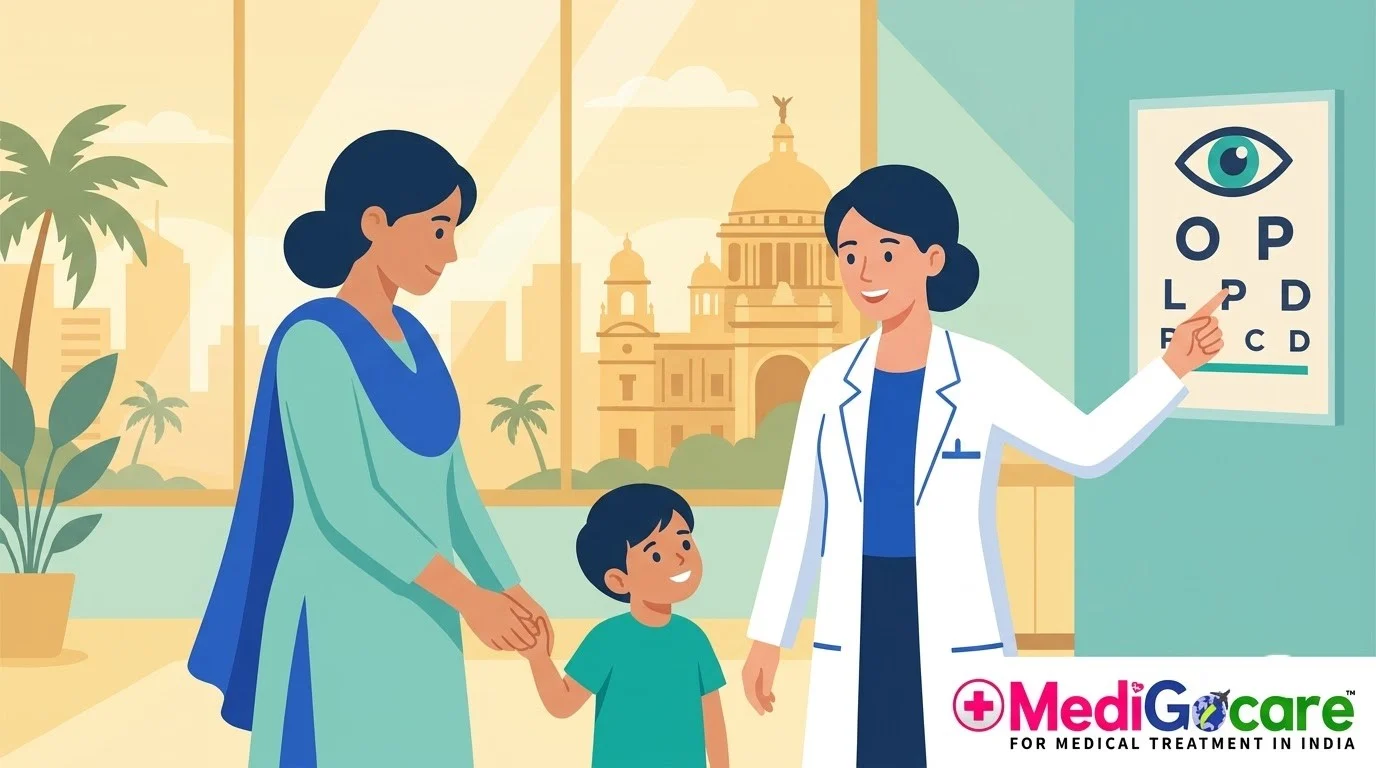
If you're reading this, you've probably just been told a word you'd never heard before a few days ago: retinoblastoma. Or maybe a photo of your child looked strange to you, and someone mentioned it, and now you're here at 2am trying to understand what's happening.
We want to say this clearly, right at the start: retinoblastoma is one of the most treatable cancers in all of paediatric medicine, and when it's caught early, the outlook is genuinely good. That's not a marketing line. It's what the research actually shows.
This guide covers everything a parent needs to know — what retinoblastoma is, the warning signs, why so many families from Kenya, Nigeria, Tanzania, Ghana, Uganda, and beyond travel to India for treatment, what it costs, and exactly how the journey works from your first message to us through to going home.
Let's start with the part that matters most.
Retinoblastoma is a cancer that starts in the retina — the layer at the back of the eye that senses light and sends signals to the brain. It's rare overall, but it's the most common eye cancer in children, and it almost always shows up before the age of five.
It happens because of a change in a gene called RB1, which normally stops cells from growing out of control. Sometimes that change is inherited, and sometimes it just happens on its own, with no family history at all. Either way, it's nobody's fault. That's worth saying plainly, because we've had parents ask us this question in almost every consultation.
The cancer can affect one eye (unilateral) or both (bilateral). It can stay contained inside the eye, or, if it's caught late, it can spread beyond it. That difference — contained versus spread — is the single biggest factor in how treatment goes. Which brings us to the sign every parent should know.
Most parents don't find out from a doctor first. They find out from a photograph.
The medical term is leukocoria — a white or yellowish glow in the pupil, instead of the normal red-eye reflex you'd expect in a flash photo. Some families describe it as a "cat's eye" look. It shows up because the tumour reflects light differently than a healthy retina does.

Here's what's useful to know about it:
We'll say this as directly as we can: if you've noticed a white or yellow glow in your child's eye — in a photo or in person — please don't wait for a "better" moment to look into it. Book an eye exam. Most causes of leukocoria turn out to be something other than retinoblastoma. But the only way to know is to check, and checking costs you nothing.
This is the part of the story that doesn't get told often enough, and it's the reason we wanted to write this guide.
A 2024 study looked at 958 retinoblastoma patients across 41 African countries and found survival of 78.2% at one year, dropping to 66.2% at three years. Compare that with a separate study from Côte d'Ivoire and the DRC, where children arrived at treatment centres an average of 14 months after the first symptom appeared — and by then, most already had proptosis, meaning the disease had grown beyond the eye itself. Three-year survival in that group was 29%.
That's not a small gap. That's the difference early action can make.
There's a genuinely hopeful example here too. Kenya set up a national retinoblastoma strategy group back in 2008, focused specifically on faster diagnosis and referral. Survival rates there rose from around 30% to 70%. Same disease, same country — just caught sooner and treated faster. The World Health Organization has since named retinoblastoma one of six index cancers under its Global Initiative for Childhood Cancer, precisely because outcomes can improve this dramatically with the right systems in place.
So here's the honest version of what we tell every family: retinoblastoma caught while it's still inside the eye is a very different situation from retinoblastoma that's had over a year to grow. The treatment is often gentler, the eye can more often be saved, and survival is excellent. That's why this section exists before the one about hospitals or cost — because timing changes the whole conversation.
Once a family has decided to travel, the next question is always: why India, specifically?
A few honest reasons keep coming up in our conversations with parents:
And one more thing, and we say this because it matters practically, not just as a selling point: MediGoCare has a branch office in Dar es Salaam, Tanzania, alongside our main coordination team in Gurugram. For East African families especially, that means there's someone reachable close to home, in the same time zone, before you even think about a flight.
Treatment depends on the stage — how much of the eye is involved, whether one eye or both are affected, and whether the disease has spread beyond the eye. In broad terms, here's what's available:

We know that last option is the hardest one to read about. We won't pretend otherwise. But it's also worth knowing that enucleation, when it's needed, is a well-established, safe procedure, and children go on to do very well with a prosthetic eye afterward. Our team will walk you through every option honestly — including telling you plainly when eye removal genuinely is the safer path, not just presenting it as a last resort to be feared.
This is where a lot of the information online gets confusing, because the numbers you'll find range from around $600 all the way to over $40,000 — for what looks like the same procedure. That's not because someone's lying. It's because "retinoblastoma treatment" isn't one single price. It depends entirely on which of the treatments above your child needs, and how many rounds of it.
Here's a realistic breakdown, based on current published ranges:
| Treatment scenario | Approximate cost (USD) |
|---|---|
| Unilateral (one eye), chemotherapy + focal therapy | $4,000 – $9,000 |
| Bilateral (both eyes), chemotherapy + multiple focal sessions | $8,000 – $18,000 |
| Intra-arterial chemotherapy, per procedure | $2,000 – $3,500 |
| Enucleation with prosthetic eye fitting | $1,500 – $3,000 |
| Advanced or extraocular disease | Assessed individually — this needs a full case review, not a general figure |
These are indicative ranges, not fixed quotes. Your actual estimate depends on your child's stage, which eye or eyes are involved, and the specific hospital and specialists. We'll confirm the real number in writing once we've reviewed your child's reports — free of charge, and with no obligation.
We'd rather tell you this upfront than have it surprise you later.
None of this is meant to alarm you. It's meant to help you plan properly, so there are no surprises halfway through.
Here's what actually happens, step by step, from your first message to us.
We won't give you a single "average" number for how long this takes, because it genuinely depends on the stage and treatment type. What we will do is give you our honest best estimate for your child's specific situation, before you book a single flight.

Tata Memorial Centre in Mumbai runs one of Asia's most experienced paediatric oncology units, and its team regularly treats retinoblastoma, neuroblastoma, and childhood leukaemia — including a meaningful number of patients travelling from Nigeria, Bangladesh, and East Africa. We coordinate directly with paediatric ocular oncology teams at centres like this, matching your child's specific case to the right specialists rather than a generic hospital list.
We'll be upfront about one thing: we only publish the names of doctors and hospitals we've directly confirmed as active treatment partners. If your child's case needs a specialist outside our current confirmed network, we'll tell you that honestly and help you find the right option — even if it means recommending a route we don't handle directly.
We're based in Gurugram, right alongside major hospitals like Medanta, Fortis, and Artemis — which means our coordinators can walk into a department in person, not just make a phone call. And for families in East Africa, our Tanzania office in Dar es Salaam means you're not starting this conversation from scratch with someone thousands of miles away.
We won't promise you a number we can't back up, and we won't tell you an eye can be saved when the honest answer is that it can't. What we will do is give you a straight, written assessment, coordinate every part of the trip so you're not managing logistics on top of everything else, and stay in touch long after you've flown home.
The most common first sign is leukocoria — a white or yellowish glow in the pupil, usually noticed in a flash photograph or in dim light. A second sign, strabismus (crossed or misaligned eyes), sometimes appears alongside it or on its own.
It could mean several things, and retinoblastoma is just one possible cause. But because it's the most serious one, it's always worth getting checked by an eye doctor rather than waiting to see if it happens again.
It depends heavily on the stage and treatment type. Broadly, unilateral (one-eye) cases range from about $4,000–$9,000, bilateral cases from $8,000–$18,000, and individual intra-arterial chemotherapy procedures from $2,000–$3,500. We provide a written, case-specific estimate free of charge after reviewing your child's reports.
Often, yes — especially when the disease is caught while it's still contained inside the eye. Treatments like intra-arterial chemotherapy and plaque radiotherapy are specifically designed to save the eye and preserve as much vision as possible. In more advanced cases, saving the eye may not be safely possible, and we'll always tell you that honestly rather than promise otherwise.
It varies significantly by how early the disease is caught. A 2024 study across 41 African countries found 78.2% survival at one year and 66.2% at three years overall. In high-income countries, where diagnosis tends to happen earlier, survival exceeds 95%. The gap comes down almost entirely to how early treatment starts.
It depends on the treatment plan. Intra-arterial chemotherapy is often given over several sessions spaced weeks apart. Systemic chemotherapy courses can run for months. We'll give you a realistic timeline specific to your child's case before you travel.
Yes. India's Medical Attendant Visa allows up to two family members to accompany a patient, linked directly to the child's medical visa.
Ideally: any photos showing the white-eye reflex, ultrasound or scan reports if already done, notes from your paediatrician or ophthalmologist, and your child's basic medical history. If you're missing something, send what you have — we'll tell you what else is needed.
Some cases are inherited, and some happen spontaneously with no family history at all. If your child's case turns out to be the inherited form, genetic counselling and testing for siblings is usually recommended, and we can help coordinate this.
It's treatable, but the approach is different and more intensive, often combining chemotherapy with other treatments depending on where it has spread. This is exactly the kind of case that needs an individual specialist review rather than a general answer — send us the reports, and we'll be straightforward with you about what the options genuinely are.
You'll apply for India's e-Medical Visa online, using the hospital invitation letter we provide once your treatment plan is confirmed. It typically takes 3–5 working days and costs $25–30. We guide you through every document, step by step.
Tell us honestly where your budget sits. We'll help you understand what's realistic, flag any lower-cost pathway that may fit your child's specific case, and point you toward charitable or hospital-based support options where they exist. We'd rather have that honest conversation early than have a family arrive and find themselves stuck.
If you've read this far, you're probably carrying a lot right now. We understand that. Send us your child's reports through WhatsApp — +91 90858 83067 — or email info@medigocare.com, and we'll come back to you with an honest, written assessment. No obligation, and no charge for the review.
Chat with MediGoCare on WhatsAppExplore our full Cancer Treatment in India services, or read our Complete Guide to Cancer Treatment in India for International Patients.
24/7 Assistance with the best medical care at your service
Quality treatment with professional & unmatched personal care
Our experts make your Communication easier and more transparent

