24/7 Customer Assistance
24/7 Assistance with the best medical care at your service

Call us for any question
+91 90858 83067BLOCK-B, PH-1, Sushant Lok Phase I, Gurugram, Haryana 122001
IndiaOffice Hour: 09:00am - 09:00pm
info@medigocare.com
Published: June 2026 | Medically reviewed by: Kuldeep Chetry & Medigocare Team
When a cataract clouds the natural lens of your eye, a surgeon removes it and replaces it with an artificial one — an intraocular lens, or IOL. The removal is the standard part. The IOL choice is the personal part, and it shapes how well you see for the rest of your life. Unlike glasses, which can be changed whenever your prescription shifts, an IOL is permanent. It does not wear out, does not require maintenance, and — barring rare complications — does not come out.
This makes the lens decision genuinely consequential. The good news is that there is a clear framework for navigating it. This guide explains each IOL type in plain language, what the clinical evidence says about outcomes, and how to match the right lens to your eyes and lifestyle. For patients considering cataract surgery in India, there is also a price breakdown by lens type at the end.
Your natural lens sits just behind the iris (the coloured part of your eye). Its job is to focus incoming light onto the retina at the back of the eye. When proteins in the lens clump and cloud it — forming a cataract — that focusing function is disrupted. Vision becomes hazy, colours look washed out, and bright lights cause glare.
The surgeon removes the clouded natural lens using ultrasound (phacoemulsification) through a tiny 2–3mm incision and replaces it with a clear artificial IOL. The IOL is folded for insertion, then unfurls inside the capsular bag that previously held your natural lens.
The critical difference between IOL types is not what they replace — they all do the same thing there. The difference is how many distances they allow you to focus at. Your natural lens, when young and healthy, changes shape to focus at different distances — a process called accommodation. IOLs are fixed-focus optics; they cannot physically change shape (with one limited exception, discussed below). The type of IOL you choose determines which distances you see clearly without glasses after surgery.
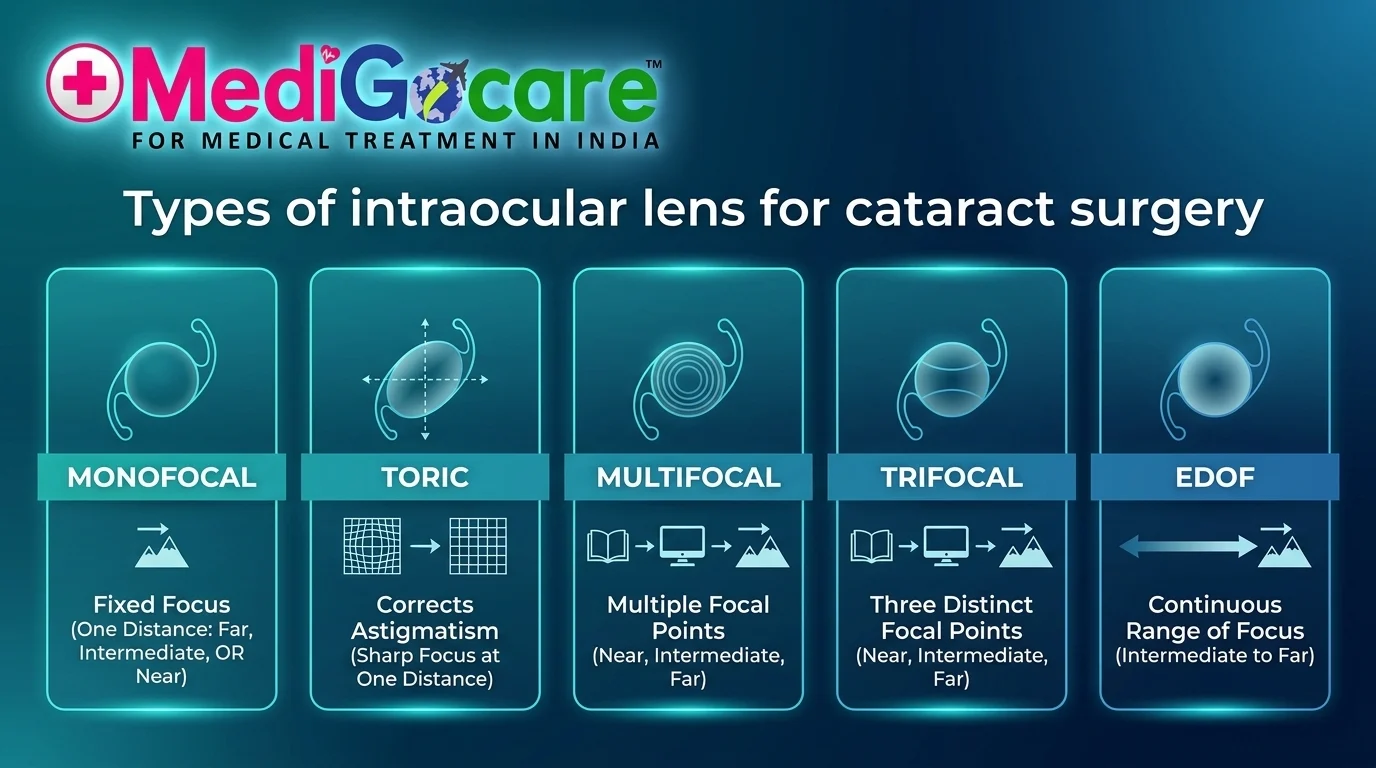
Monofocal is the original IOL design and still the most widely used worldwide. It focuses at a single distance — almost always set for clear far vision, so you can see road signs, television screens and faces without glasses. For near tasks — reading, checking your phone, looking at a menu — you will need reading glasses.
Who monofocal suits: patients who are happy using reading glasses and want the clearest, most predictable distance vision. Patients who drive frequently at night. Patients with retinal conditions, including diabetic eye disease, where splitting light between focal zones can reduce clarity. Patients on a tighter budget.
The clinical case for monofocal: monofocal IOLs deliver the highest contrast sensitivity and the fewest visual disturbances of any IOL category. They produce minimal haloes and no light-splitting artefacts. In India, where the rate of undiagnosed early diabetic retinopathy and subtle macular changes is significant — India carries the world's second-largest diabetes burden, with 89 million people living with the condition — many experienced surgeons prefer monofocal lenses for their diabetic cataract patients even when premium options are available. An eye with early retinal compromise simply gets less out of multifocal optics and more out of their drawbacks.
The monovision option: some patients opt for "blended monovision" — setting one eye for distance and one for near. This is a strategic approach using two monofocal lenses to cover a wider range without the optical trade-offs of multifocal designs. It suits some patients very well; others find the initial asymmetry uncomfortable. It should be trialled with contact lenses before committing.
Price in India: ₹17,000–₹40,000 per eye for phacoemulsification with a standard monofocal IOL, depending on the lens brand and hospital.

A standard monofocal IOL corrects the cataract but does nothing for astigmatism — the irregular corneal curvature that causes blurring at all distances. If you have significant astigmatism and receive a standard lens, you will still need glasses for clear distance vision after surgery, which rather defeats the purpose of the premium cataract procedure.
A toric IOL solves this by combining the standard focal correction with a cylindrical correction precisely aligned to your corneal astigmatism. During surgery, the lens is carefully rotated to align with your corneal axis. The result: one procedure addresses both the cataract and the astigmatism simultaneously.
Toric lenses are available in monofocal, multifocal and EDOF versions. A monofocal toric gives sharp distance vision with astigmatism corrected; you still need reading glasses. Multifocal toric and trifocal toric add near/intermediate focus on top of the astigmatism correction, for patients who want maximum glasses freedom.
Who toric suits: any cataract patient with meaningful astigmatism — broadly, more than 1.0 dioptre of corneal astigmatism, though your surgeon assesses this precisely with corneal topography. Without toric correction, the astigmatism will simply remain after surgery.
Price in India: ₹50,000–₹90,000 per eye for phacoemulsification with a toric IOL, depending on the degree of astigmatism correction and lens brand.
Multifocal and trifocal IOLs use diffractive optics — concentric ring zones engineered into the lens surface — to split incoming light between multiple focal points simultaneously. Your visual system and brain then select the appropriate focal image depending on what you are looking at. The aim is to give clear vision at two (multifocal) or three (trifocal) distances without glasses.
Multifocal IOLs typically create two dominant focal zones: distance and near. Modern bifocal-range multifocals handle reading and driving well. Intermediate distances — computer screens, dashboard displays, supermarket shelves at arm's length — can still require some effort or mild glasses.
Trifocal IOLs add the third focal zone for intermediate distances, completing the range. The Alcon AcrySof IQ PanOptix (and its 2026 successor the Clareon PanOptix Pro) is the most widely implanted trifocal globally, FDA-approved specifically to improve both intermediate and near visual acuity. Johnson & Johnson announced FDA approval of the TECNIS PureSee IOL in March 2026, described as a breakthrough that provides improved visual range for cataract patients. In the 2026 IOL Preferences Survey by Review of Ophthalmology, the Clareon PanOptix Pro Trifocal was chosen by 34.5% of surveyed surgeons for presbyopia-correcting cases.
What the evidence says: a 2025 meta-analysis of 1,000 patients found 89% satisfaction in the 45–50-year age group with multifocal IOLs. However, the honest picture on side effects is important. A 2016 Cochrane review found that visual disturbances — haloes and glare — were more prevalent and more troublesome with multifocal compared to monofocal IOLs (relative risk for glare: 1.41). In real-world studies with the PanOptix trifocal, halo was reported by 43.4% of patients and glare by 14.4% — but when asked how bothersome these were, only 1.4% of patients found either symptom troubling. The distinction between "I sometimes notice this" and "this bothers me significantly" is important context.
Neuroadaptation: most patients with premium IOLs notice visual disturbances — haloes, slight ghosting, variation in clarity at different distances — in the first weeks after implantation. This is normal. The brain adapts over six to twelve weeks as it learns to process the new optical input, and most disturbances diminish substantially. Patients who understand this in advance tolerate the initial period far better than those who are surprised by it. The Asia-Pacific Professors of Ophthalmology (AAPPO) consensus guidelines emphasise that if a patient has not adapted after this period, options including IOL exchange should be discussed — but this is uncommon in well-screened candidates.
Who multifocal/trifocal suits: motivated patients who want maximum glasses independence for daily activities, with healthy maculae (no diabetic maculopathy, no age-related macular disease), healthy optic nerves and good corneas. Patients who do not drive significant distances at night in the first months, or who are comfortable with a period of adaptation. Active professionals who use screens regularly — trifocal's intermediate zone is particularly valued by computer users.
Who multifocal/trifocal does NOT suit: patients with diabetic retinopathy, macular oedema, glaucoma with field loss, significant dry eye, or irregular corneas. Patients with unrealistic expectations of achieving perfect vision at all distances in all conditions. Patients whose primary concern is driving at night with maximum contrast sensitivity. In these cases, monofocal or EDOF is the more appropriate recommendation.
Price in India: Indian/mid-range multifocal IOLs with phacoemulsification cost ₹45,000–₹65,000 per eye. Premium imported multifocal IOLs (PanOptix, Symfony and others) run ₹65,000–₹85,000 per eye. Trifocal IOLs are ₹90,000–₹1,40,000 per eye.

Extended Depth of Focus lenses work on a fundamentally different principle from multifocals. Rather than splitting light into two or three distinct focal points, EDOF IOLs elongate the focal zone into a continuous range — stretching it from far out to about arm's length. The result is fluid, seamless vision across a wide span of distances, with a notably smoother experience than the zonal transitions of multifocal optics.
The leading EDOF IOLs in the 2026 market include the Alcon Vivity (and its toric version, the Vivity Toric) — the most commonly chosen presbyopia-correcting IOL in the 2026 IOL Preferences Survey, selected by 39.7% of surveyed surgeons. A surgeon from Maryland quoted in the survey summarised the clinical logic: "I mostly use EDOF IOLs to avoid glare symptoms associated with multifocals, though I use PanOptix in select patients." The Johnson & Johnson PureSee, FDA-approved in March 2026, is a purely refractive EDOF lens that a July 2025 peer-reviewed study found delivers superior uncorrected intermediate vision compared to enhanced monofocal IOLs.
What EDOF gives you: excellent distance and intermediate vision — driving, computers, televisions, faces, signs, dashboards. Fine print reading (small text on a medication label, a newspaper in small font) may still require reading glasses in some patients, particularly in low light. Most patients can manage most reading tasks without glasses, especially in good light.
What EDOF trades away: it does not match the near-vision performance of a premium trifocal in good conditions. Patients who do a great deal of close reading under varied lighting may find trifocal better suited.
Why EDOF is particularly valued: fewer night-vision disturbances than multifocal. Lower risk of neuroadaptation difficulties. Better choice for patients with mild dry eye or slightly irregular corneas where a diffractive multifocal would be less advisable. Ideal for frequent night drivers who still want intermediate vision coverage.
Who EDOF suits: patients who want a clear range of functional vision — especially far to intermediate — without the commitment to the adaptation process of a multifocal. Drivers. Computer users. Patients with mild co-morbidities that make multifocal less ideal but who still want better than distance-only vision.
Price in India: ₹55,000–₹1,00,000 per eye for EDOF IOL with phacoemulsification.
The right IOL is the one matched to your eyes and your life — not the most expensive one, not the most technologically impressive one, and not the one that worked well for your friend. Here is the honest decision framework.
The decision your surgeon should make with you: a complete pre-operative assessment — corneal topography, macular OCT scan, measurement of pupil size in dim light, evaluation of tear film and dry eye, and a frank conversation about your lifestyle and expectations — is the only basis on which the right IOL can be selected. No lens choice should be made from a website alone.
This is the section missing from every IOL explainer blog on the current SERP.
| IOL type | India (per eye, surgery included) | In USD (approx.) |
|---|---|---|
| Standard monofocal IOL | ₹17,000–₹40,000 | ~$200–$480 |
| Toric IOL | ₹50,000–₹90,000 | ~$600–$1,080 |
| Indian/mid-range multifocal IOL | ₹45,000–₹65,000 | ~$540–$780 |
| Premium imported multifocal IOL | ₹65,000–₹85,000 | ~$780–$1,020 |
| Trifocal IOL | ₹90,000–₹1,40,000 | ~$1,080–$1,680 |
| EDOF IOL | ₹55,000–₹1,00,000 | ~$660–$1,200 |
| Laser-assisted (FLACS, add-on) | +₹40,000–₹80,000 | +~$480–$960 |
Indicative 2026 prices at accredited private hospitals. The price includes pre-operative biometry, the surgical procedure and the specified IOL. Your confirmed all-inclusive quote from MediGoCare specifies the exact lens brand.

For comparison, premium trifocal cataract surgery in the United States runs USD 5,000–8,000 per eye out of pocket. The same outcome — same lens brands, same phacoemulsification technique — is available in India at 75–80% less.
For a complete procedure-by-procedure price guide, see our eye surgery cost in India page. To get a quote specific to your prescription and lens preference, see the cataract surgery in India page or send your reports directly on WhatsApp (+91 90858 83067).
There is no universal best — the right lens depends on your eyes, lifestyle and visual goals. Monofocal lenses give sharp distance vision with excellent contrast sensitivity, at the lowest cost. Multifocal and trifocal lenses reduce dependence on glasses at all distances but require suitable eyes and an adaptation period. Toric lenses correct astigmatism. EDOF lenses offer a smooth range with fewer night disturbances. A complete pre-operative assessment determines which type suits your specific case.
A monofocal IOL focuses at one distance (usually far), giving sharp distance vision — you will need reading glasses for close work. A multifocal IOL splits light between focal zones to provide distance and near vision, reducing glasses dependence significantly. Multifocals can cause mild haloes or glare — especially in low light — that settle over six to twelve weeks as the brain adapts. Which is better depends entirely on your eye health and what you want from your vision.
Yes. The intraocular lens implanted during cataract surgery is designed to remain in your eye permanently. It does not wear out, does not need cleaning, and does not need replacement in the vast majority of cases. It is not the same as a contact lens and requires no daily maintenance.
Trifocal IOLs come closest to spectacle independence, providing near, intermediate and distance focus — and many patients do manage most activities without glasses. A 2025 meta-analysis found 89% satisfaction in patients receiving presbyopia-correcting IOLs. However, no lens can guarantee complete glasses freedom in all conditions for all patients. Some patients still need glasses for very fine print in low light, even with premium trifocal lenses.
Premium multifocal and trifocal IOLs in India range from approximately ₹65,000 to ₹1,40,000 per eye including surgery — roughly USD 780–1,680. This is 70–80% less than equivalent premium cataract surgery in the United States or United Kingdom, using the same international-brand IOLs. EDOF IOLs cost ₹55,000–₹1,00,000 per eye including surgery.
A toric IOL is specifically designed to correct astigmatism during cataract surgery. It combines the focal correction with a cylindrical correction precisely aligned to your corneal axis. Without a toric lens, your astigmatism will remain after surgery and you will still need glasses for clear distance vision. Toric versions are available for all IOL types — monofocal toric, multifocal toric, trifocal toric and EDOF toric.
Medical disclaimer: This article is for general information purposes and does not constitute medical advice. IOL selection must be determined by a qualified ophthalmologist based on a full pre-operative assessment of your individual eyes. Price figures are indicative estimates. Last reviewed: June 2026.
Get a personalized quote specific to your prescription and lens preference from MediGoCare today.
24/7 Assistance with the best medical care at your service
Quality treatment with professional & unmatched personal care
Our experts make your Communication easier and more transparent

